
Cuvillier Verlag GmbH



| Departments | |
|---|---|
| Book Series (99) |
1415
|
| Nachhaltigkeit |
3
|
| Gesundheitswesen |
3
|
| Humanities |
2411
|
| Natural Sciences |
5430
|
| Mathematics | 230 |
| Informatics | 320 |
| Physics | 982 |
| Chemistry | 1371 |
| Geosciences | 131 |
| Human medicine | 246 |
| Stomatology | 10 |
| Veterinary medicine | 112 |
| Pharmacy | 147 |
| Biology | 837 |
| Biochemistry, molecular biology, gene technology | 121 |
| Biophysics | 25 |
| Domestic and nutritional science | 45 |
| Agricultural science | 1006 |
| Forest science | 201 |
| Horticultural science | 20 |
| Environmental research, ecology and landscape conservation | 149 |
| Engineering |
1821
|
| Common |
97
|
|
Leitlinien Unfallchirurgie
5. Auflage bestellen |
|
Advanced Search
Spektroellipsometrische Untersuchungen zum Grenzflächenerstarren der fluiden Legierungssysteme Gallium / Bismut, Gallium / Blei und Gallium / Thallium (English shop)
Kai Bartel (Author)Preview
Table of Contents, Datei (36 KB)
Extract, Datei (89 KB)
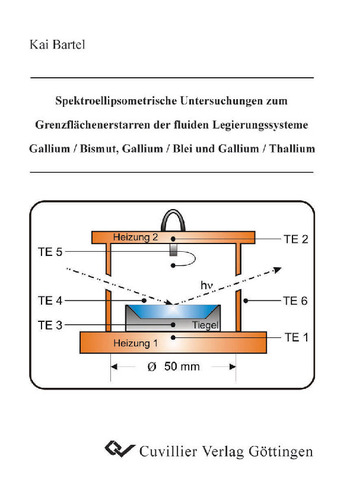
This thesis presents spectroellipsometric investigations of surface freezing in binary, gallium-rich alloys with concentrations between the monotectic and eutectic points. The central question was how surface freezing is influenced by the temperature conditions prevailing at the surface. The alloy systems selected were all to exhibit the same type of phase diagram with a pronounced miscibility gap, and the respective pure components were to differ sufficiently from one another in their optical properties. On this basis, the binary systems gallium / bismuth, gallium / lead and gallium / thallium were chosen, in which surface freezing can be studied at relatively low temperatures below 300°C. The experiments employed a phase-modulation ellipsometer permanently mounted on a UHV recipient. To investigate the temperature dependence of surface freezing, a special device (a “cap”) was developed which, on the one hand, provided additional heating from above and, on the other hand, ensured almost complete thermal shielding of the samples and thus homogeneous and well-defined temperature conditions as well as a minimisation of the temperature gradients occurring at the surface. Surface freezing could thus be investigated on a large number of samples with regard to the variation of temperature gradient, cooling rate, concentration and system. Particular attention was also devoted to the cleanliness of the metal surfaces used and to their cleaning under vacuum.
| ISBN-13 (Printausgabe) | 3867272069 |
| ISBN-13 (Hard Copy) | 9783867272063 |
| ISBN-13 (eBook) | 9783736922068 |
| Final Book Format | A5 |
| Language | German |
| Page Number | 162 |
| Edition | 1 |
| Volume | 0 |
| Publication Place | Göttingen |
| Place of Dissertation | Karlsruhe |
| Publication Date | 2007-04-02 |
| General Categorization | Dissertation |
| Departments |
Chemistry
|
| Keywords | Ellipsometry, interfacial freezing, surface freezing, interfacial phase transitions, alloys |


