
Cuvillier Verlag GmbH



| Departments | |
|---|---|
| Book Series (99) |
1415
|
| Nachhaltigkeit |
3
|
| Gesundheitswesen |
3
|
| Humanities |
2415
|
| Natural Sciences |
5432
|
| Mathematics | 230 |
| Informatics | 320 |
| Physics | 982 |
| Chemistry | 1371 |
| Geosciences | 131 |
| Human medicine | 247 |
| Stomatology | 10 |
| Veterinary medicine | 112 |
| Pharmacy | 147 |
| Biology | 838 |
| Biochemistry, molecular biology, gene technology | 121 |
| Biophysics | 25 |
| Domestic and nutritional science | 45 |
| Agricultural science | 1006 |
| Forest science | 201 |
| Horticultural science | 20 |
| Environmental research, ecology and landscape conservation | 149 |
| Engineering |
1822
|
| Common |
97
|
|
Leitlinien Unfallchirurgie
5. Auflage bestellen |
|
Advanced Search
Elektrochemische Ceroxid-Funktionsschichten hergestellt durch Sol-Gel-Verfahren (English shop)
Untersuchungen zum Zusammenhang zwischen elektrochemischem Verhalten und Herstellung beziehungsweise Nachbehandlung
Stefan Krebs (Author)Preview
Table of Contents, Datei (56 KB)
Extract, Datei (92 KB)
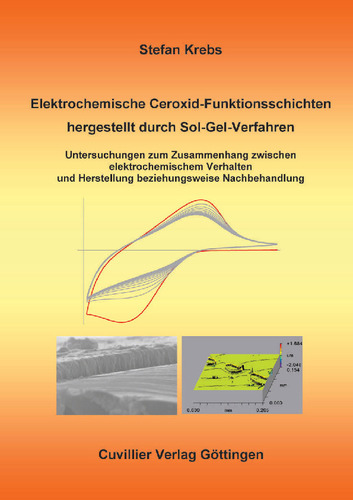
The aim of the present work was to prepare CeO2 films by sol-gel processes and to characterise the electrochemical behaviour of these films. Cyclic voltammetry, galvanostatic measurements, potential step measurements and impedance spectroscopy were employed as electrochemical investigation methods.
CeO2 electrodes are used technically in electrochromic applications. In principle, these are electrochemical cells with an electrochromic electrode (e.g. WO3) and a counter electrode (e.g. CeO2), into which Li+ ions can be intercalated reversibly and without any colour change.
The glass substrates used for the preparation of the CeO2 films were sputter-coated with antimony-doped SnO2 (“ATO”) in order to provide electrical contact to these films. The sol used for dip-coating was prepared on the basis of inorganic chemicals. SEM investigations and cyclic voltammetric measurements indicated a functional film densely packed with nanometre-sized particles.
Differently prepared CeO2 electrodes as well as, for comparison, a platinum and an ATO electrode were investigated electrochemically both using aqueous electrolytes (0.1 M LiOH, KOH, NH3 and LiClO4) and the non-aqueous electrolyte consisting of 0.1 M LiClO4 in propylene carbonate (“PC”). It could be shown that fundamentally different electrochemical processes take place at a CeO2 electrode than at a platinum or an ATO electrode, namely an intercalation and deintercalation of lithium ions. However, at all electrodes, when the non-aqueous electrolyte is used, surface coverages arise at very negative electrode potentials due to the decomposition of the solvent propylene carbonate. By means of galvanostatic investigations, the maximum intercalatable charge for a 50 nm thick CeO2 film was determined to be 12.5 mC/cm2, which corresponds to an intercalation concentration of 1.6 ∙ 10^22 Li+ ions per cm3 of CeO2.
A CeO2 film in contact with an electrolyte exhibited a pronounced ageing process. In the case of the non-aqueous electrolyte, the “reactivation” of an aged electrode with respect to the intercalatable charge could be achieved by polarisation to a very positive electrode potential or by repeated annealing.
All electrochemical investigation methods showed that intercalation is kinetically more strongly hindered than deintercalation. The largest possible degree of intercalation was achieved when the period of time for intercalation was extended. Thus, for kinetic reasons, intercalation takes place only within an “effective” film thickness. Within the framework of a model, the intercalation process within this “effective” film thickness was described.
The results of cyclic voltammetric and galvanostatic measurements indicated that there are two potential ranges in which intercalation and deintercalation take place. On this basis, a model of a “density of states function” of the intercalation sites in a CeO2 film was established. By applying a potential-dependent distribution function, the functional relationship between the degree of intercalation and the electrode potential was calculated numerically.
On this basis, potential step measurements were simulated numerically. From the results of the experimentally performed potential step measurements, with the aid of the aforementioned simulation, the order of magnitude of the chemical diffusion coefficient of lithium (Li+ + e-) in CeO2 was determined to be 1 ∙ 10^-13 cm2/s. Starting from this value of the diffusion coefficient, simulations of the galvanostatic and cyclic voltammetric measurements were also carried out. The potential-time curves and the current-potential curves calculated in this way were compared with the corresponding measured curves.
| ISBN-13 (Printausgabe) | 3867271798 |
| ISBN-13 (Hard Copy) | 9783867271790 |
| ISBN-13 (eBook) | 9783736921795 |
| Final Book Format | A5 |
| Language | German |
| Page Number | 284 |
| Edition | 1 |
| Volume | 0 |
| Publication Place | Göttingen |
| Place of Dissertation | Dormund |
| Publication Date | 2007-03-08 |
| General Categorization | Dissertation |
| Departments |
Chemistry
|


