
Cuvillier Verlag GmbH



| Departments | |
|---|---|
| Book Series (99) |
1415
|
| Nachhaltigkeit |
3
|
| Gesundheitswesen |
3
|
| Humanities |
2412
|
| Natural Sciences |
5430
|
| Mathematics | 230 |
| Informatics | 320 |
| Physics | 982 |
| Chemistry | 1371 |
| Geosciences | 131 |
| Human medicine | 246 |
| Stomatology | 10 |
| Veterinary medicine | 112 |
| Pharmacy | 147 |
| Biology | 837 |
| Biochemistry, molecular biology, gene technology | 121 |
| Biophysics | 25 |
| Domestic and nutritional science | 45 |
| Agricultural science | 1006 |
| Forest science | 201 |
| Horticultural science | 20 |
| Environmental research, ecology and landscape conservation | 149 |
| Engineering |
1821
|
| Common |
97
|
|
Leitlinien Unfallchirurgie
5. Auflage bestellen |
|
Advanced Search
Systematische Untersuchungen zur Eignung von K-Carrageenan als Pelletierhilfsstoff in der Feuchtextrusion/ Sphäronisation (English shop)
Markus Thommes (Author)Preview
Table of Contents, Datei (53 KB)
Extract, Datei (150 KB)
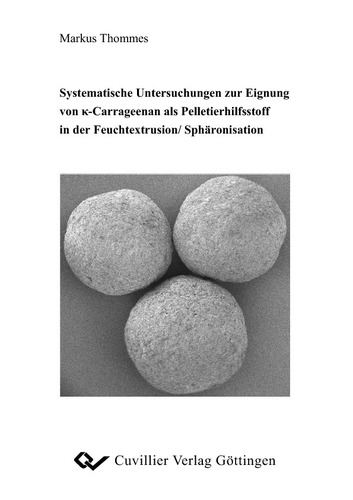
Using κ-carrageenan, numerous formulations comprising six drug substances and four fillers could be processed into pellets with suitable properties. In contrast to MCC, the pelletisation of κ-carrageenan required larger proportions of water in order to obtain comparable pelletisation properties of the extrudates. The sensitivity of the process to moisture fluctuations in the extrudate is reduced compared with MCC. Owing to low shrinkage during drying, κ-carrageenan pellets have a higher porosity and lower mechanical stability than pellets made from MCC. At a constant κ-carrageenan content, the type and proportion of the formulation constituents had little influence on the pellet properties. Thus, all pellets exhibited rapid disintegration and fast drug release. Exceptions to this are cationic substances, in which an ionic interaction with the acidic κ-carrageenan presumably occurred. An influence on the pellet properties could be determined both for free calcium ions in dicalcium phosphate and for the basic drug substances when processed below the pKa value. Four different κ-carrageenan products from various manufacturers enabled pelletisation by means of extrusion/spheronisation. Despite minor differences between the carrageenans, the resulting pellets possessed comparable properties. Numerous process parameters such as the extrudate moisture content, the number of holes in the die plate, the spheroniser rotation speed, the residence time in the spheroniser and the drying temperature influenced the pellet properties. For example, drying above 70 °C led to lower mechanical strength and faster drug release, caused by chain scission of the κ-carrageenan. High drug loadings of 95% are achievable when using κ-carrageenan as a pelletisation aid. Owing to the high robustness of the process towards fluctuations in extrudate moisture and the establishment of a dynamic equilibrium during extrusion, there are no objections to the large-scale industrial use of κ-carrageenan as a pelletisation aid.
| ISBN-13 (Printausgabe) | 3865379532 |
| ISBN-13 (Hard Copy) | 9783865379535 |
| ISBN-13 (eBook) | 9783736919532 |
| Language | German |
| Page Number | 122 |
| Edition | 1 |
| Volume | 0 |
| Publication Place | Göttingen |
| Place of Dissertation | Düsseldorf |
| Publication Date | 2006-07-21 |
| General Categorization | Dissertation |
| Departments |
Pharmacy
|


