
Cuvillier Verlag GmbH



| Departments | |
|---|---|
| Book Series (99) |
1415
|
| Nachhaltigkeit |
3
|
| Gesundheitswesen |
3
|
| Humanities |
2412
|
| Natural Sciences |
5430
|
| Mathematics | 230 |
| Informatics | 320 |
| Physics | 982 |
| Chemistry | 1371 |
| Geosciences | 131 |
| Human medicine | 246 |
| Stomatology | 10 |
| Veterinary medicine | 112 |
| Pharmacy | 147 |
| Biology | 837 |
| Biochemistry, molecular biology, gene technology | 121 |
| Biophysics | 25 |
| Domestic and nutritional science | 45 |
| Agricultural science | 1006 |
| Forest science | 201 |
| Horticultural science | 20 |
| Environmental research, ecology and landscape conservation | 149 |
| Engineering |
1821
|
| Common |
97
|
|
Leitlinien Unfallchirurgie
5. Auflage bestellen |
|
Advanced Search
Entwicklung eines an den Elementarbereich anschlussfähigen Sachunterrichts mit Themen der unbelebten Natur (English shop)
Björn Risch (Author)Preview
Extract, PDF (130 KB)
Table of Contents, PDF (68 KB)
Björn Risch
Summary of the dissertation
Development of primary science teaching (Sachunterricht) on topics of inanimate nature that builds on early childhood education
Children’s interest in the natural sciences is once again receiving greater attention. Experiments on inanimate nature have meanwhile become firmly established in numerous curricula for early childhood education, ensuring that more and more kindergarten children develop great enthusiasm for independent “research” and experimentation. In the primary school sector, however, appropriate teaching content is still largely lacking to satisfy the scientific curiosity of young pupils.
An analysis of the Sachunterricht curricula of all German federal states makes clear that topics from the fields of chemistry and physics are markedly underrepresented. It is therefore not surprising that, in this respect, Germany ranks last in comparison with the other German-speaking countries.
Within the framework of the research project, an introductory primary-level course on topics of inanimate nature was developed that is capable of building on – that is, continuing from – the kindergarten years, in order to lay the foundations for teaching physical and chemical content already at these age levels. The elaboration of these subject areas comprises both didactic methods of instruction and suggestions for experimental implementation.
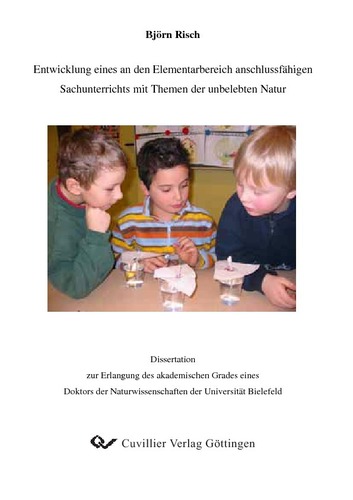
After conducting a number of experimental lessons in primary schools, a remarkable developmental-psychological aspect was observed: whereas kindergarten children are eager to learn while experimenting and demand explanations by asking “why” questions, for primary school children their own activity – that is, DOING, and here especially the making of things – takes centre stage. Questions about the “why” are mostly absent. And yet evaluations show that even months later the children remember the experiments and their interpretations in precise detail.
| ISBN-13 (Printausgabe) | 3865377831 |
| ISBN-13 (Hard Copy) | 9783865377838 |
| ISBN-13 (eBook) | 9783736917835 |
| Final Book Format | A5 |
| Language | German |
| Page Number | 276 |
| Edition | 1 Aufl. |
| Volume | 0 |
| Publication Place | Göttingen |
| Place of Dissertation | Bielefeld |
| Publication Date | 2006-02-01 |
| General Categorization | Dissertation |
| Departments |
Chemistry
|


