
Cuvillier Verlag GmbH



| Departments | |
|---|---|
| Book Series (99) |
1415
|
| Nachhaltigkeit |
3
|
| Gesundheitswesen |
3
|
| Humanities |
2412
|
| Natural Sciences |
5430
|
| Mathematics | 230 |
| Informatics | 320 |
| Physics | 982 |
| Chemistry | 1371 |
| Geosciences | 131 |
| Human medicine | 246 |
| Stomatology | 10 |
| Veterinary medicine | 112 |
| Pharmacy | 147 |
| Biology | 837 |
| Biochemistry, molecular biology, gene technology | 121 |
| Biophysics | 25 |
| Domestic and nutritional science | 45 |
| Agricultural science | 1006 |
| Forest science | 201 |
| Horticultural science | 20 |
| Environmental research, ecology and landscape conservation | 149 |
| Engineering |
1821
|
| Common |
97
|
|
Leitlinien Unfallchirurgie
5. Auflage bestellen |
|
Advanced Search
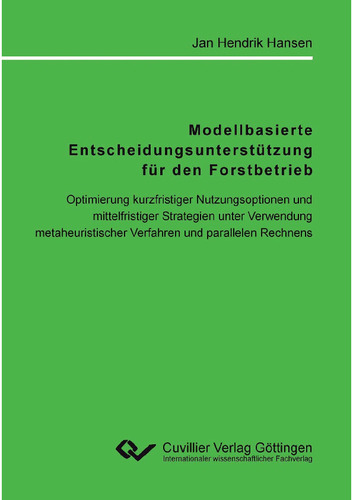
Modellbasierte Entscheidungsunterstützung für den Forstbetrieb (English shop)
Optimierung kurzfristiger Nutzungsoptionen und mittelfristiger Strategien unter Verwendung metaheuristischer Verfahren und parallelen Rechnens
Jan Hendrik Hansen (Author)Preview
Table of Contents, Datei (53 KB)
Extract, Datei (79 KB)
Due to the dynamics of natural and anthropogenically created framework conditions as well as the increasing demands on forest functions in Germany, planning silvicultural measures is an increasingly complex task. If additional information and improved planning tools are available, higher-quality decisions can be made.
In this work, a practicable decision support system (DSS) is developed which can be applied in forest enterprise planning and which combines fundamental functions/models (GIS, simulation of growth and interventions, optimisation of silvicultural questions) in a user-friendly application.
At the first decision support level of the system, indicators of various forest functions are generated on the basis of inventory or forest management planning data. The second level offers the possibility of simulating silvicultural scenarios and subsequently comparing alternatives. At the third level, optimal management recommendations for different questions are determined automatically.
One focus of this work is the development of the optimisation system. Taking user-specific objectives into account, it determines management plans for the following problems: (1) stand selection for the provision of defined assortments, (2) optimisation of harvesting and tending, and (3) optimal selection of nature conservation areas. For this purpose, the integrated models are coupled with an optimisation procedure (simulation-based optimisation). Metaheuristic procedures are particularly suitable in this respect, as they place only minor requirements on the structure of the problem to be solved and can search large solution spaces efficiently. In order to determine a specific procedure for the presented DSS, various standard procedures are modified (initialisation, termination control, parallelisation) and compared with regard to their solution speed and solution quality.
Since the generation of development paths is very computationally intensive in the context of comparing alternatives, and above all in simulation-based optimisation, a further focus is placed on the parallelisation of the entire simulation system. This makes it possible to exploit all available system resources (multi-core and multiprocessor systems, clusters) and to reduce the system’s response times considerably.
Finally, an application example is presented and discussed with regard to the calculation of decision-relevant indicators, the simulation of alternatives and the generation of optimal management options.
| ISBN-13 (Printausgabe) | 3954041006 |
| ISBN-13 (Hard Copy) | 9783954041008 |
| ISBN-13 (eBook) | 9783736941007 |
| Final Book Format | A5 |
| Language | German |
| Page Number | 228 |
| Lamination of Cover | matt |
| Edition | 1 Aufl. |
| Volume | 0 |
| Publication Place | Göttingen |
| Place of Dissertation | Göttingen |
| Publication Date | 2012-05-09 |
| General Categorization | Dissertation |
| Departments |
Forest science
|


