
Cuvillier Verlag GmbH



| Departments | |
|---|---|
| Book Series (99) |
1415
|
| Nachhaltigkeit |
3
|
| Gesundheitswesen |
3
|
| Humanities |
2412
|
| Natural Sciences |
5430
|
| Mathematics | 230 |
| Informatics | 320 |
| Physics | 982 |
| Chemistry | 1371 |
| Geosciences | 131 |
| Human medicine | 246 |
| Stomatology | 10 |
| Veterinary medicine | 112 |
| Pharmacy | 147 |
| Biology | 837 |
| Biochemistry, molecular biology, gene technology | 121 |
| Biophysics | 25 |
| Domestic and nutritional science | 45 |
| Agricultural science | 1006 |
| Forest science | 201 |
| Horticultural science | 20 |
| Environmental research, ecology and landscape conservation | 149 |
| Engineering |
1821
|
| Common |
97
|
|
Leitlinien Unfallchirurgie
5. Auflage bestellen |
|
Advanced Search
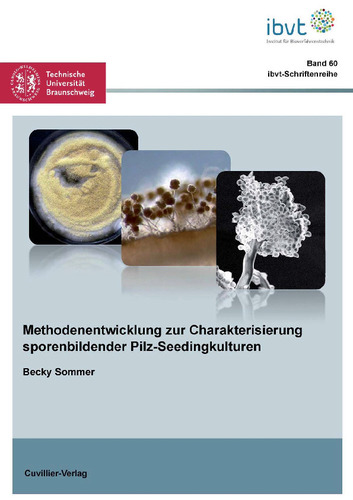
Methodenentwicklung zur Charakterisierung sporenbildender Pilz-Seedingkulturen (Volume 60) (English shop)
Becky Sommer (Author)Preview
Table of Contents, Datei (44 KB)
Extract, Datei (49 KB)
In production processes involving filamentous fungi, spores are frequently used as starter cultures for submerged cultivations. In this context it is essential to know the specific characteristics of the spores contained in the inoculum, since these can influence the success and reproducibility of the cultivation. Due to a lack of analytical methods, it has so far not been possible to determine specific properties of spores in the inoculum. This work therefore focuses on establishing methods for the characterisation and quality assessment of spores in seeding cultures. Using the model organism Aspergillus ochraceus, it is shown that a live/dead viability test based on confocal laser scanning microscopy is suitable for quantifying membrane-intact, germinable spores. Furthermore, it is demonstrated that the FDA assay detects biomass activity in the initial phase of submerged cultivation, thus allowing initial predictions about the success of the cultivation. In addition, the applicability of the tetrazolium salt MTT for detecting the respiratory activity of spore suspensions is confirmed. The polyol content of the spores correlates with the germination potential and can therefore likewise be used as a quality indicator for seeding cultures. The analytical methods established in this work are applied to identify optimal sporulation parameters for maximum spore yields with high spore quality. The results of the various characterisation methods correlate with one another as well as with biomass growth and biotransformation performance in the submerged cultivation process.
With the aid of the methods developed here for the characterisation and quality assessment of seeding cultures, statements about the success or failure of a cultivation are now possible even before it begins. Furthermore, conclusions can be drawn regarding optimal sporulation conditions, and spore suspensions of high viability can be produced in future, thereby contributing to quality assurance of the cultivation process.
| ISBN-13 (Printausgabe) | 3869558512 |
| ISBN-13 (Hard Copy) | 9783869558516 |
| ISBN-13 (eBook) | 9783736938519 |
| Final Book Format | A5 |
| Language | German |
| Page Number | 136 |
| Lamination of Cover | matt |
| Edition | 1 Aufl. |
| Book Series | Schriftenreihe des Institutes für Bioverfahrenstechnik der Technischen Universität Braunschweig |
| Volume | 60 |
| Publication Place | Göttingen |
| Place of Dissertation | TU Braunschweig |
| Publication Date | 2011-09-05 |
| General Categorization | Dissertation |
| Departments |
Biophysics
|
| Keywords | Aspergillus ochraceus, filamentous fungus, spores, sporulation, quality assurance, viability |


