
Cuvillier Verlag GmbH



| Departments | |
|---|---|
| Book Series (99) |
1410
|
| Nachhaltigkeit |
3
|
| Gesundheitswesen |
3
|
| Humanities |
2401
|
| Medienwissenschaften | 16 |
| Theology | 57 |
| Philosophy | 103 |
| Law | 427 |
| Economics | 861 |
| Social sciences | 423 |
| Sports science | 48 |
| Psychology | 233 |
| Educational science | 190 |
| History | 190 |
| Art | 111 |
| Cultural studies | 167 |
| Literary studies | 117 |
| Linguistics | 90 |
| Natural Sciences |
5426
|
| Engineering |
1817
|
| Common |
97
|
|
Leitlinien Unfallchirurgie
5. Auflage bestellen |
|
Advanced Search
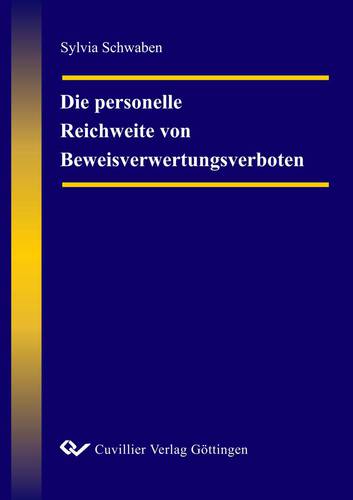
Die personelle Reichweite von Beweisverwertungsverboten (English shop)
Sylvia Schwaben (Author)Preview
Table of Contents, Datei (84 KB)
Extract, Datei (110 KB)
Ob Beweise, die unter Verstoß gegen gesetzliche Bestimmungen erlangt wurden, verwertet werden dürfen, wird im Strafprozeßrecht seit langer Zeit intensiv diskutiert. Unter welchen Umständen ein Beweisverwertungsverbot entsteht, wird von der Strafprozeßordnung nicht erschöpfend beantwortet. Es war vielmehr Aufgabe der Rechtsprechung Verwertungsverbote zu begründen. Die personelle Reichweite eines Beweisverwertungsverbots, also die Frage, wer einen Verstoß gegen das Verfahrensrecht geltend machen kann bzw. für wen ein bestehendes Verwertungsverbot wirkt, hat der Bundesgerichtshof im Fall von § 55 StPO entschieden und damit die sog. Rechtskreistheorie begründet. Anhand von Gesetz, Rechtsprechung und Literatur belegt die Arbeit, daß Grundlage eines Beweisverwertungsverbots der Folgenbeseitigungsanspruch ist. Hieraus wird sodann auf die Reichweite eines Verwertungsverbots geschlossen.
| ISBN-13 (Printausgabe) | 3865374174 |
| ISBN-13 (Hard Copy) | 9783865374172 |
| ISBN-13 (eBook) | 9783736914179 |
| Final Book Format | A5 |
| Language | German |
| Page Number | 220 |
| Edition | 1 |
| Volume | 0 |
| Publication Place | Göttingen |
| Place of Dissertation | Göttingen |
| Publication Date | 2005-04-15 |
| General Categorization | Dissertation |
| Departments |
Law
|


