
Cuvillier Verlag GmbH



| Departments | |
|---|---|
| Book Series (99) |
1415
|
| Nachhaltigkeit |
3
|
| Gesundheitswesen |
3
|
| Humanities |
2411
|
| Natural Sciences |
5429
|
| Mathematics | 230 |
| Informatics | 320 |
| Physics | 982 |
| Chemistry | 1371 |
| Geosciences | 131 |
| Human medicine | 246 |
| Stomatology | 10 |
| Veterinary medicine | 112 |
| Pharmacy | 147 |
| Biology | 837 |
| Biochemistry, molecular biology, gene technology | 121 |
| Biophysics | 25 |
| Domestic and nutritional science | 45 |
| Agricultural science | 1005 |
| Forest science | 201 |
| Horticultural science | 20 |
| Environmental research, ecology and landscape conservation | 148 |
| Engineering |
1821
|
| Common |
97
|
|
Leitlinien Unfallchirurgie
5. Auflage bestellen |
|
Advanced Search
Gelatinefilme als Arzneistoffträger (English shop)
Martin Ulrich Renner (Author)Preview
Table of Contents, Datei (56 KB)
Preface, Datei (29 KB)
Extract, Datei (110 KB)
This work investigates the suitability of gelatin films as drug carriers. The aim is the slowest possible constant drug release from gelatin matrices with a modified structure. Various changes in the structure are intended to result in low diffusion and release rates. To achieve constant release, multilayer systems with a concentration gradient are prepared.
To characterise the gelatin structure, gelatin films are prepared in different ways and examined by DSC. The thermogram shows a glass transition, which describes the increase in the mobility of the polypeptide chains, and the melting peak. The formation of crystalline triple helices of the gelatin decreases with increasing drying temperature of the gelatin sol. At temperatures above the melting temperature of the gelatin gels, no crystalline fractions can be detected any longer. The gelatin framework is present in the amorphous random-coil state. Below this melting temperature, triple helices are formed, resulting in the semi-crystalline gel form. Subsequent drying of the films leads, due to the decreasing water content, to a reversible increase in the glass transition and melting temperature and to a reduction of the melting enthalpy. Hardening reagents such as bis-vinyl sulfones, added to the gelatin sol, cross-link the polypeptide chains of the gelatin. As a result, the crystalline regions decrease, since triple helices can no longer form. Owing to the reduced mobility of the chains, the glass transition temperature rises. Furthermore, it is shown that the swelling factor and the water vapour sorption decrease with increasing degree of hardening, due to the denser structure.
Diffusion experiments show that mass transport through the gelatin films and the diffusion coefficient within them decrease with increasing hardening. Cross-linking creates a denser framework, which constitutes a greater diffusion barrier. Comparative experiments with a stirred and an unstirred donor compartment reveal that the water layer between the sediment and the clamped gelatin film has, on account of its considerable thickness, a strong influence on the mass flux. Hardening after film formation permits a further reduction of the diffusion coefficient, since crystalline triple-helix regions can still form during the preparation of the gelatin films. They contribute to the diffusion resistance.
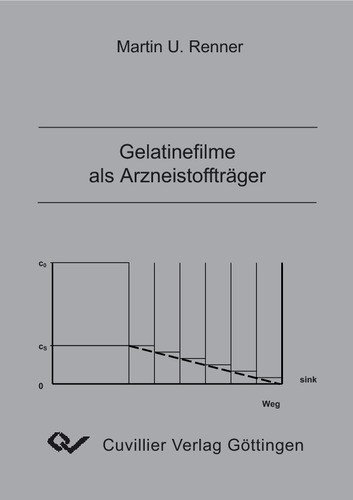
Release studies with hardened single-layer matrices show a release profile following square-root-of-time kinetics for both solution and suspension matrices. From this the diffusion coefficient can be calculated. For solution matrices it agrees with that obtained from diffusion experiments. In suspension matrices it is higher, owing to the pore-forming drug particles. With large drug particles, sedimentation may occur during preparation, leading to a lower concentration in the upper part of the films and thus to an initially retarded release. Two-layer systems, with a suspension matrix at the bottom and a solution matrix or an empty layer on top, show an initial burst effect or a lag time in the release profile. During this initial phase, a linear concentration gradient, decreasing from bottom to top, becomes established in the upper layer. Once the concentration in this layer has fallen or risen to 50 % of the saturation concentration, the further release proceeds practically linearly. Since the upper layer is relatively thick, only a short, practically linear section from the end of the square-root-of-time kinetics of the suspension matrices comes into play. By means of numerical simulation, the release profile can be reproduced well in both phases. Multilayer gelatin matrices prepared by the cascade casting method consist of many layers with different amounts of drug. On top of the lower suspension matrix lie several layers with a concentration gradient decreasing towards the top. The state reached after the initial phase of release from two-layer matrices is thus already attained.
Constant release from multilayer matrices can therefore be achieved by deliberately adjusting the concentrations in the individual layers.
| ISBN-13 (Printausgabe) | 3865372503 |
| ISBN-13 (Hard Copy) | 9783865372505 |
| ISBN-13 (eBook) | 9783736912502 |
| Language | German |
| Page Number | 164 |
| Edition | 1 |
| Volume | 0 |
| Publication Place | Göttingen |
| Place of Dissertation | Göttingen |
| Publication Date | 2004-12-18 |
| General Categorization | Dissertation |
| Departments |
Pharmacy
|


