
Cuvillier Verlag GmbH



| Departments | |
|---|---|
| Book Series (99) |
1415
|
| Nachhaltigkeit |
3
|
| Gesundheitswesen |
3
|
| Humanities |
2413
|
| Natural Sciences |
5430
|
| Mathematics | 230 |
| Informatics | 320 |
| Physics | 982 |
| Chemistry | 1371 |
| Geosciences | 131 |
| Human medicine | 246 |
| Stomatology | 10 |
| Veterinary medicine | 112 |
| Pharmacy | 147 |
| Biology | 837 |
| Biochemistry, molecular biology, gene technology | 121 |
| Biophysics | 25 |
| Domestic and nutritional science | 45 |
| Agricultural science | 1006 |
| Forest science | 201 |
| Horticultural science | 20 |
| Environmental research, ecology and landscape conservation | 149 |
| Engineering |
1822
|
| Common |
97
|
|
Leitlinien Unfallchirurgie
5. Auflage bestellen |
|
Advanced Search
Bestimmung und Optimierung von Colchicin-Alternativen für die Doppelhaploiden-Technik bei Mais (Zea mays L.) (English shop)
Katharina Rosalie Häntzschel (Author)Preview
Table of Contents, Datei (51 KB)
Extract, Datei (600 KB)
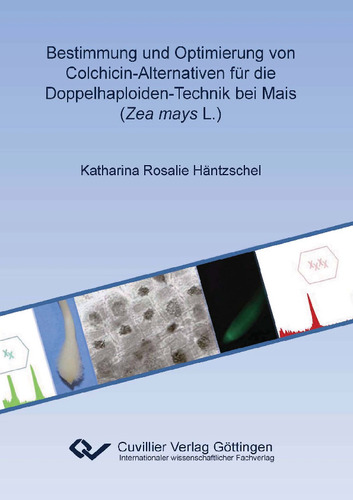
In maize breeding, the doubled haploid technique represents a time-saving alternative to the conventional production of homozygous lines. The DH technique can be divided into two steps: 1.) the induction of maternal haploids by pollination with so-called inducer lines and 2.) the doubling of the chromosome sets to generate doubled haploids by treatment with a mitotic poison. Overall, between 1 – 10 % haploids or doubled haploids can be produced at each step. This therefore still indicates a considerable potential for optimisation. On the one hand, the mechanism of haploid induction has not yet been fully elucidated and the induction rates are in part strongly dependent on the respective genotype. On the other hand, the alkaloid colchicine, which is highly toxic in particular to mammals, is still very frequently used for the doubling of the chromosome sets. Due to its low specificity for plant spindles, a relatively high amount of colchicine is required, which makes its application expensive and, above all, hazardous for the user.
The aim of the present work was to improve the doubled haploid technique in maize by identifying less toxic and, as far as possible, efficient colchicine alternatives. For this purpose, the following working steps were carried out:
- Assessment of possible colchicine alternatives by treatment of root tips (chemical substances, physical methods).
- Optimisation of the incubation parameters for the treatment of haploids with colchicine alternatives.- Identification of new colchicine alternatives via high-throughput screening of a chemical library.
- Investigation of the mechanism of haploid induction.
In the treatment of root meristems it could be shown that the three herbicides APM, oryzalin and pronamide can be used as colchicine alternatives. Compared with colchicine, they all exhibit a considerably lower toxicity for mammals. In addition, owing to the considerably lower concentrations required, their use would also be more cost-efficient than a colchicine treatment. After the treatment of haploids, however, no doubled haploids could be produced with any of the alternative treatments to date.
The treatment parameters for colchicine could be further optimised within the framework of the present work. Thus, aeration of the treatment solution resulted in a clear increase in seedling vitality. Furthermore, the largest number of seedlings with a doubled chromosome set could be produced after the treatment of two-day-old seedlings. Because of the promising properties of the herbicides APM, oryzalin and pronamide, further experiments should be carried out as soon as larger quantities of haploid seed are available.
The screening procedure of the LATCA library using a transgenic Arabidopsis thaliana line proved to be extremely effective for the identification of mitotic inhibitors. After carrying out the screening of ~3600 chemical substances in three stages, 51 candidate colchicine alternatives could be identified. These substances should be evaluated in more detail by treatment of haploid maize seedlings. The screening of further libraries for the discovery of mitotic inhibitors would also be conceivable.
Through a better understanding of the mechanism of haploid induction, this technique could be improved and thus the use of colchicine reduced. On the basis of the results obtained so far, however, no statements can be made about the mechanism of haploid induction. The test system used should therefore be optimised further.
The present work was able to show that the efficiency of producing doubled haploid maize plants could be improved by the use of colchicine alternatives. In addition, after a screening of ~3600 chemical substances by means of A. thaliana, 51 chemicals could be detected as potential mitotic inhibitors.
| ISBN-13 (Printausgabe) | 3869558385 |
| ISBN-13 (Hard Copy) | 9783869558387 |
| ISBN-13 (eBook) | 9783736938380 |
| Final Book Format | A5 |
| Language | German |
| Page Number | 129 |
| Lamination of Cover | glossy |
| Edition | 1 Aufl. |
| Volume | 0 |
| Publication Place | Göttingen |
| Place of Dissertation | Universität Hohenheim |
| Publication Date | 2011-08-03 |
| General Categorization | Dissertation |
| Departments |
Agricultural science
|


