
Cuvillier Verlag GmbH



| Departments | |
|---|---|
| Book Series (99) |
1415
|
| Nachhaltigkeit |
3
|
| Gesundheitswesen |
3
|
| Humanities |
2412
|
| Medienwissenschaften | 17 |
| Theology | 57 |
| Philosophy | 103 |
| Law | 430 |
| Economics | 863 |
| Social sciences | 423 |
| Sports science | 48 |
| Psychology | 233 |
| Educational science | 190 |
| History | 194 |
| Art | 111 |
| Cultural studies | 168 |
| Literary studies | 119 |
| Linguistics | 91 |
| Natural Sciences |
5430
|
| Engineering |
1821
|
| Common |
97
|
|
Leitlinien Unfallchirurgie
5. Auflage bestellen |
|
Advanced Search
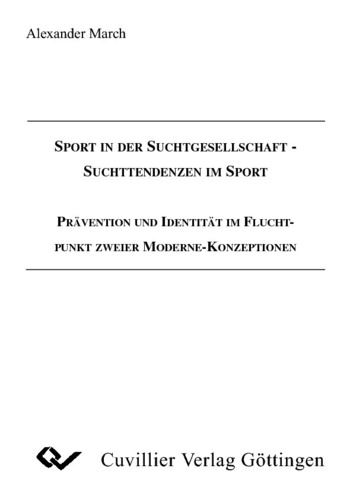
Sport in der Suchtgesellschaft – Suchttendenzen im Sport (English shop)
Prävention und Identität im Fluchtpunkt zweier Moderne-Konzeptionen
Alexander March (Author)Preview
Table of Contents, Datei (66 KB)
Extract, Datei (74 KB)
Starting from the claim that sport has a positive function in addiction prevention, this study poses the question of what function sport must have in people’s lives in order to be able to prevent addictive behaviours. To this end, the phenomenon of addiction is first placed in the context of everyday identity work. Essential to this “anthropological understanding” is the dissociation of addiction and illness, together with the endeavour not to differentiate between individual forms of addiction but rather to demonstrate their commonalities. On the basis of this anthropological approach, the transformation of the forms of addiction in the process of modernisation is then analysed. Drawing on characteristic differences in identity work, various phases of modernisation are distinguished from one another, each of which can be assigned a characteristic function of addiction. Sport and prevention are examined in the same way across the different phases. It emerges that current attempts to justify sport as a component of addiction prevention are based on outdated assumptions, both regarding the function of sport and regarding the function of addictive behaviours. A pattern becomes apparent of making sport usable as a “functional alternative” for preventive purposes, which suggests that sport itself possesses addictive potential. Addiction prevention is deciphered as a specific conception of reality in each case. From this perspective, the possibility that addiction, as a culturally and socially conditioned phenomenon, might be curable is rejected. Rather, the “invention” of addiction serves to maintain a “cultural self-narrative” according to which identity is to be realised individually. In conclusion, the study points out prospectively in which direction the potential of sport would have to be exploited in order to eliminate addiction – and with it prevention – from the constructions of reality of individuals against the background of postmodern plurality.
Review of Alexander March: Sport in der Suchtgesellschaft – Suchttendenzen im Sport. Prävention und Identität im Fluchtpunkt zweier Moderne-Konzeptionen
In his study, Alexander March uncovers a close connection between today’s sporting practices and addictive forms of behaviour: everyday life today has become “sportified”, and this does not, as is commonly claimed, have an addiction-preventive effect but, on the contrary, this tendency promotes addiction-like needs. In an impressive analysis of previous surges of social modernisation, the author shows that addiction conceals a failing form of the search for identity. Addiction is interpreted here as a defence against the experience of meaninglessness and as an expression of a rigidified relation to the self. The focus of the investigation is directed at the changed socio-psychological significance of today’s sporting activities and the self-misunderstandings of current conceptions of addiction prevention through sport. The unfolding of this basic thesis is, in its pointedness, stimulating as a diagnosis of the times and convincing in its argumentation.
Prof. Dr. Thomas Ziehe, Universität Hannover
| ISBN-13 (Printausgabe) | 3865372201 |
| ISBN-13 (Hard Copy) | 9783865372208 |
| ISBN-13 (eBook) | 9783736912205 |
| Language | German |
| Page Number | 210 |
| Edition | 1 |
| Volume | 0 |
| Publication Place | Göttingen |
| Place of Dissertation | Göttingen |
| Publication Date | 2004-09-20 |
| General Categorization | Dissertation |
| Departments |
Social sciences
Sports science |


