
Cuvillier Verlag GmbH



| Departments | |
|---|---|
| Book Series (99) |
1415
|
| Nachhaltigkeit |
3
|
| Gesundheitswesen |
3
|
| Humanities |
2410
|
| Medienwissenschaften | 17 |
| Theology | 57 |
| Philosophy | 103 |
| Law | 430 |
| Economics | 863 |
| Social sciences | 423 |
| Sports science | 48 |
| Psychology | 233 |
| Educational science | 190 |
| History | 194 |
| Art | 111 |
| Cultural studies | 167 |
| Literary studies | 118 |
| Linguistics | 90 |
| Natural Sciences |
5428
|
| Engineering |
1821
|
| Common |
97
|
|
Leitlinien Unfallchirurgie
5. Auflage bestellen |
|
Advanced Search
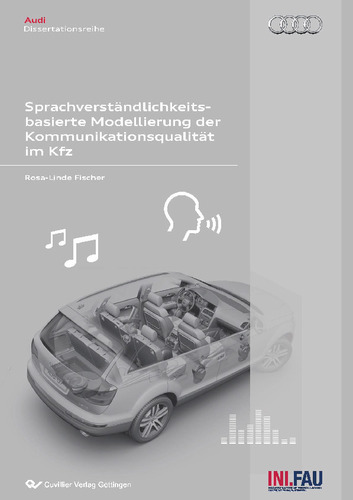
Sprachverständlichkeitsbasierte Modellierung der Kommunikationsqualität im Kfz (Volume 46) (English shop)
Rosa-Linde Fischer (Author)Preview
Table of Contents, Datei (91 KB)
Extract, Datei (59 KB)
In the development of Audi AG’s infotainment systems, alongside sound quality—on the basis of which the infotainment systems are primarily optimised for music reproduction—speech intelligibility is to be brought into focus in quality assessment. This requirement arises from the fact that speech content is increasingly being used in vehicles.
The literature on speech quality showed that speech intelligibility is only one attribute of the multidimensional construct of speech quality, but a very important one. If speech intelligibility is poor, it dominates speech quality. Only once a high degree of speech intelligibility has been achieved do other quality attributes gain influence. The advantage of speech intelligibility is that, unlike other quality dimensions, it can be described as an almost objective criterion. The disadvantage of speech intelligibility is its rapid saturation with increasing speech signal-to-noise ratio (SNR). In this range, subjective quality attributes still reflect differences in the acoustic conditions. A further advantage of speech intelligibility is that, for some acoustic conditions, well-evaluated objective measurement instruments exist for its prediction—the speech indices, such as the Speech Intelligibility Index (SII) and the Speech Transmission Index (STI). However, there are hardly any studies on the predictive quality of the speech indices under the specific acoustic conditions in a vehicle.
One task of this work was therefore to systematically investigate the quality of various speech indices when applied in the vehicle. On the basis of the theoretical accounts it could furthermore be deduced that speech intelligibility is indeed a necessary but not a sufficient attribute of a good listening situation. For this reason, the contribution of the speech indices to determining communication quality in the vehicle was also investigated.
To this end, a wide variety of acoustic conditions in the vehicle were recorded in the first part of the work and subsequently analysed. The results showed that a very complex acoustic situation prevails in vehicles, both with regard to the background noise situation and to the speech transmission paths. Some of these recordings were then used in the experiments assessing speech intelligibility (Experiments 1 and 2) and communication quality (Experiment 3).
For the empirical assessment of speech intelligibility in Experiments 1 and 2, the signals recorded in the vehicle were presented to the test subjects via headphones. A speech intelligibility test was conducted with the subjects under the presented speech signal–background noise conditions. More precisely, the Speech Reception Threshold (SRT) was determined for each of these conditions by adaptively establishing the speech level that, at a constant background noise level, led to a speech intelligibility of 50%. In addition, the SRT was modelled using the speech indices, namely on the basis of the speech signal and background noise spectra of the conditions and the hearing threshold of the test subjects. The comparison of the empirical SRTs with the SRTs calculated by the speech indices led to the determination of the model quality of the speech indices in the vehicle.
In Experiment 1, speech intelligibility was investigated under various vehicle conditions with a focus on different background noises; in Experiment 2 the emphasis was on the speech transmission paths in the vehicle.
The results showed that, following an extension in the low-frequency range, the models are able to predict the SRTs very well under the various driving conditions. This applied both to the normal-hearing and to the hearing-impaired test subjects. However, the model quality differed between the various speech indices and the conditions investigated.
The best overall prediction was achieved with a binaural approach. This showed both the highest absolute model quality and the highest correlation with the empirical SRTs across the conditions investigated.
Owing to the complexity of the acoustic conditions in the vehicle, the causes of the fluctuations in model quality could not be clearly attributed. On the basis of the available data, however, suggestions could be derived for improving the models in individual situations.
For the investigation of communication quality in Experiment 3, following the work of various authors, the items concentration (listening effort), annoyance, loudness of the sentences and subjective speech intelligibility were investigated under the construct of communication quality.
Since other authors had already been able to show that one of the speech indices exhibited a high relationship with the subjective quality dimension of listening effort, this part of the work was intended to investigate the contribution of the speech indices to the objective determination of communication quality.
Accordingly, the focus of the investigations in Experiment 3 was on the relationship between the speech indices and speech intelligibility or communication quality above the SRT. The results showed, for both the normal-hearing and the hearing-impaired subjects, that communication quality above the SRT is more sensitive to differences in the acoustic conditions than objective speech intelligibility. Moreover, it could be shown that in this range the speech indices exhibit a stronger relationship with communication quality than with speech intelligibility.
In agreement with the findings from the literature, it can therefore be assumed that above the SRT the speech indices predict subjective measures, such as the communication quality investigated here, and not speech intelligibility.
| ISBN-13 (Printausgabe) | 3869558202 |
| ISBN-13 (Hard Copy) | 9783869558202 |
| ISBN-13 (eBook) | 9783736938205 |
| Final Book Format | A5 |
| Language | German |
| Page Number | 196 |
| Lamination of Cover | matt |
| Edition | 1 Aufl. |
| Book Series | Audi Dissertationsreihe |
| Volume | 46 |
| Publication Place | Göttingen |
| Place of Dissertation | Universität Erlangen-Nürnberg |
| Publication Date | 2011-07-29 |
| General Categorization | Dissertation |
| Departments |
Psychology
|


