
Cuvillier Verlag GmbH



| Departments | |
|---|---|
| Book Series (99) |
1415
|
| Nachhaltigkeit |
3
|
| Gesundheitswesen |
3
|
| Humanities |
2412
|
| Natural Sciences |
5430
|
| Mathematics | 230 |
| Informatics | 320 |
| Physics | 982 |
| Chemistry | 1371 |
| Geosciences | 131 |
| Human medicine | 246 |
| Stomatology | 10 |
| Veterinary medicine | 112 |
| Pharmacy | 147 |
| Biology | 837 |
| Biochemistry, molecular biology, gene technology | 121 |
| Biophysics | 25 |
| Domestic and nutritional science | 45 |
| Agricultural science | 1006 |
| Forest science | 201 |
| Horticultural science | 20 |
| Environmental research, ecology and landscape conservation | 149 |
| Engineering |
1821
|
| Common |
97
|
|
Leitlinien Unfallchirurgie
5. Auflage bestellen |
|
Advanced Search
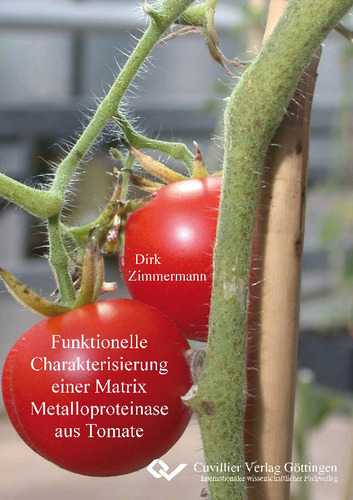
Funktionelle Charakterisierung einer Matrix Metalloproteinase aus Tomate (English shop)
Dirk Zimmermann (Author)Preview
Table of Contents, Datei (38 KB)
Extract, Datei (850 KB)
Matrix metalloproteinases (MMPs) control numerous physiological processes in zoological systems, such as embryogenesis, organogenesis, wound healing, cell division and differentiation. Their dysregulation leads to the development of major diseases such as arteriosclerosis and cancer. In plants, by contrast, the function of these enzymes is only rudimentarily understood and, in tomato plants, still unresolved.
The biochemical properties of MMP1 from tomato (SlMMP1) as well as of the recently identified SlMMP2 are known and point to a redundant function of the two proteins in vivo. Elucidating this function was the focus of the present work.
For SlMMP1 and 2, anchoring in the plasma membrane via a glycosylphosphatidylinositol (GPI) anchor is predicted. In cell cultures overexpressing SlMMP1 and in transgenic plants, an association with membrane preparations could be confirmed. For a SlMMP1-GFP fusion protein, localisation in the plasma membrane was demonstrated. GPI anchoring could not be proven beyond doubt, but a release from the membrane (“shedding”) typical of this type of anchoring was observed.
Essential for the physiological role are the substrates of proteases. In the course of this work, one of the in vivo substrates of SlMMP1/2 could be identified. It is the extracellular subtilase P69B from tomato, which is cleaved by both MMPs in vitro.
In transgenic plants that do not express the MMPs owing to RNA interference (RNAi plants), a massive accumulation of P69B occurs. The RNAi plants display a conspicuous phenotype, which manifests itself in necrotic lesions, above all on hypocotyls, but cell death events can also be observed beyond this in the rest of the plants. Transient expression of P69B in leaves of tomato and tobacco plants confirmed the involvement of the subtilase in controlled cell death. The observations suggest that SlMMP1 and 2 exert control over cell death indirectly via the cleavage of P69B. This is also consistent with the role described for P69B in pathogen defence.
These findings were confirmed by the analysis of the proteomes of wild-type and MMP-RNAi plants by 2D-DIGE. In RNAi plants, the enrichment of P69B could be demonstrated. In addition, numerous proteins involved in the stress response proved to be significantly upregulated. These included “classical” PR proteins, endochitinases, peroxidase and others. Also striking was methionine synthase, which is involved in ethylene biosynthesis. The phytohormone referred to plays a decisive role in stress reactions; its markedly increased biosynthesis in MMP-RNAi plants has already been demonstrated.
The results of this work permit the conclusion that matrix metalloproteinases in tomato are decisive factors in the response to pathogens as well as in the organisation of the apoplast. Alongside the phenotype of the RNAi plants, the results of proteomic analyses presented here offer excellent starting points for a more detailed characterisation of this protein family.
| ISBN-13 (Printausgabe) | 3869558040 |
| ISBN-13 (Hard Copy) | 9783869558042 |
| ISBN-13 (eBook) | 9783736938045 |
| Final Book Format | A5 |
| Language | German |
| Page Number | 194 |
| Lamination of Cover | glossy |
| Edition | 1 Aufl. |
| Volume | 0 |
| Publication Place | Göttingen |
| Place of Dissertation | Universität Hohenheim |
| Publication Date | 2011-07-28 |
| General Categorization | Dissertation |
| Departments |
Biology
Biochemistry, molecular biology, gene technology |


