
Cuvillier Verlag GmbH



| Departments | |
|---|---|
| Book Series (99) |
1415
|
| Nachhaltigkeit |
3
|
| Gesundheitswesen |
3
|
| Humanities |
2412
|
| Natural Sciences |
5430
|
| Mathematics | 230 |
| Informatics | 320 |
| Physics | 982 |
| Chemistry | 1371 |
| Geosciences | 131 |
| Human medicine | 246 |
| Stomatology | 10 |
| Veterinary medicine | 112 |
| Pharmacy | 147 |
| Biology | 837 |
| Biochemistry, molecular biology, gene technology | 121 |
| Biophysics | 25 |
| Domestic and nutritional science | 45 |
| Agricultural science | 1006 |
| Forest science | 201 |
| Horticultural science | 20 |
| Environmental research, ecology and landscape conservation | 149 |
| Engineering |
1821
|
| Common |
97
|
|
Leitlinien Unfallchirurgie
5. Auflage bestellen |
|
Advanced Search
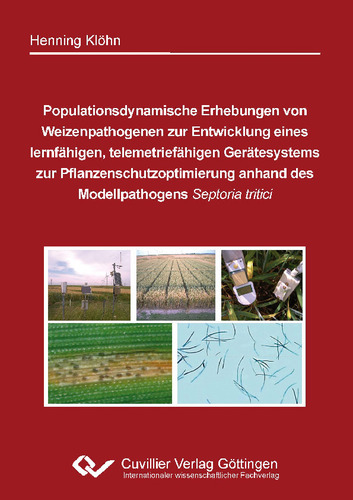
Populationsdynamische Erhebungen von Weizenpathogenen zur Entwicklung eines lernfähigen, telemetriefähigen Gerätesystems zur Pflanzenschutzoptimierung anhand des Modellpathogens Septoria tritici (English shop)
Henning Klöhn (Author)Preview
Table of Contents, Datei (58 KB)
Extract, Datei (690 KB)
The main pathogen in winter wheat, Septoria tritici, causes yield losses of 20 to 40 %. Septoria tritici was therefore chosen as a model pathogen for the development of an adaptive, telemetry-capable device system that is able to provide warning messages (via e-mail or SMS) directly to the user (farmer, consultant) on the basis of defined parameters for various pathogens and crops once an infection has been detected. This took place within the framework of a cooperation project between the Institute of Phytopathology at CAU Kiel and a software and hardware manufacturer. The weather conditions within the crop canopy exert a strong influence on the progression of the pathogen’s infestation. Besides temperature, leaf wetness must be named as a decisive influencing factor. As the canopy architecture (habitat) changes during the wheat vegetation period, the microclimates within the canopy change accordingly, which influences the development of the pathogen. After the latency period (28 days) has elapsed, the specific symptoms (pycnidia) can be diagnosed. Weather-induced quantitative and temporal differences arise in the manifestation of an epidemic between sites and years. The precise temporal determination of a Septoria tritici-specific infection event makes it possible to achieve optimal disease and yield control at an early stage in the biologically sensitive phase of the epidemic (transition from the accretion phase to the progression phase) with a fungicide input reduced to the necessary level. The trial design and the continuously conducted weather recordings at each trial site (eight) allow a site- and year-specific interpretation of the epidemics. The degree of leaf wetness and its duration constitute central influencing variables for the spread of the pathogen within the crop stand. Thus their simulation by means of a suitable sensor for recording Septoria tritici-specific, potential infection conditions was just as important a component as precise knowledge of the population and damage dynamics within a software-based algorithm in the new device system. Using a reference device established in practice (THIES CLIMA with leaf wetness sensor according to WEIHOFEN), field trials based on the IPS wheat model were carried out with four fungicide treatments (untreated control, IPS (Weihofen), ‘New System’, healthy) across Schleswig-Holstein. The treatments IPS (Weihofen) and ‘New System’ differed only in the timing of the Septoria tritici-specific fungicide applications, which were carried out according to the device-specific indication. Regular assessments showed 45 % more pycnidia at EC 75 in the ‘New System’ treatment compared with the IPS (Weihofen) treatment. Thus no improved control of the Septoria tritici epidemic was achieved in the ‘New System’ treatment, which was also documented by lower grain yields of 102.9 dt/ha (IPS 103.7 dt/ha). Under controlled conditions (climate chamber), differing progressions in the increase of Septoria tritici disease severity could be documented depending on the duration of the infection conditions at different temperatures (10 °C: sigmoidal (differentiated) and 21 °C: linear (uniform)). Trials on the drying behaviour of the leaf wetness sensors under controlled conditions in the climate chamber showed a 98 % faster drying of the new leaf wetness sensor compared with the leaf wetness sensor according to WEIHOFEN, which in field trials amounted to only 34 % faster drying. On the basis of the results presented, further research is required into the improved recording of infection conditions by the new device system in order to achieve more optimal control of the pathogen epidemic.
| ISBN-13 (Printausgabe) | 386955830X |
| ISBN-13 (Hard Copy) | 9783869558301 |
| ISBN-13 (eBook) | 9783736938304 |
| Final Book Format | A5 |
| Language | German |
| Page Number | 196 |
| Lamination of Cover | glossy |
| Edition | 1 Aufl. |
| Volume | 0 |
| Publication Place | Göttingen |
| Place of Dissertation | Universität Kiel |
| Publication Date | 2011-07-26 |
| General Categorization | Dissertation |
| Departments |
Agricultural science
|
| Keywords | Plant protection, phytopathology, Septoria tritici, infection event, latency period, pycnidia, epidemic, powdery mildew, Blumeria graminis, brown rust, Puccinia recondita, AUDPC, forecasting, optimisation, sunspots, wheat, IPS, Schleswig-Holstein |


