
Cuvillier Verlag GmbH



| Departments | |
|---|---|
| Book Series (99) |
1415
|
| Nachhaltigkeit |
3
|
| Gesundheitswesen |
3
|
| Humanities |
2415
|
| Natural Sciences |
5432
|
| Mathematics | 230 |
| Informatics | 320 |
| Physics | 982 |
| Chemistry | 1371 |
| Geosciences | 131 |
| Human medicine | 247 |
| Stomatology | 10 |
| Veterinary medicine | 112 |
| Pharmacy | 147 |
| Biology | 838 |
| Biochemistry, molecular biology, gene technology | 121 |
| Biophysics | 25 |
| Domestic and nutritional science | 45 |
| Agricultural science | 1006 |
| Forest science | 201 |
| Horticultural science | 20 |
| Environmental research, ecology and landscape conservation | 149 |
| Engineering |
1822
|
| Common |
97
|
|
Leitlinien Unfallchirurgie
5. Auflage bestellen |
|
Advanced Search
Entwicklung eines Schwingquarz-basierten Assays zur Detektion der PfEMP1-vermittelten Zytoadhäsion von Plasmodium falciparum (English shop)
Daniela Kömpf (Author)Preview
Table of Contents, Datei (66 KB)
Extract, Datei (270 KB)
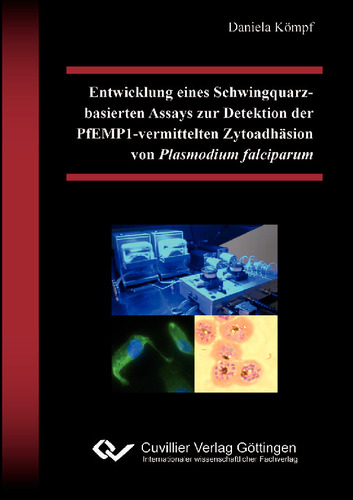
Malaria remains the most common of all tropical diseases today and, particularly in the case of malaria tropica, can trigger severe clinical manifestations. In this form, the parasitic infection leads, among other things, to damage to the brain, anaemias and, in the case of placental malaria, to miscarriages. Responsible for the development of such serious symptoms is the phenomenon of sequestration, which occurs exclusively in Plasmodium falciparum. In this process, late blood stages adhere via various parasitic proteins to the endothelium of post-capillary venules and can no longer be detected in the peripheral blood. The most important ligand in this context is the parasitic protein Plasmodium falciparum erythrocyte membrane protein 1 (PfEMP1).
The aim of the present work was to develop an adhesion assay based on quartz crystal microbalance sensing in order to gain new insights into the process of adhesion of infected cells and of individual PfEMP1 domains to the receptors CD36, chondroitin sulfate A (CSA) and ICAM-1.
To achieve this, various layer systems were developed for the immobilisation of functional receptors on the sensors. For the receptors CD36 and ICAM-1, membranes of various cell lines carrying these receptors were used. With these layers it was possible to demonstrate both the specific adhesion of infected cells to the CD36-bearing membranes and the specific binding of individual PfEMP1 domains to CD36 and ICAM-1, respectively. With regard to the domains, existing knowledge could be confirmed and new knowledge gained, since new ICAM-1-binding domains could be identified. In addition, differing affinities and binding strengths of individual domains for the receptor ICAM-1 were observed, which has hitherto not been possible with conventional methods. With respect to the investigation of the adhesion of infected cells to CSA, a CSA coating model deviating from the immobilisation methods customary in malaria research was developed, with which unambiguously specific binding events could be demonstrated. Furthermore, it was found that the bonds established between the infected cells and the receptors CD36 and CSA differed in strength.
The technology of quartz crystal microbalance biosensing thus possesses enormous potential for malaria research compared with conventional methods. The results obtained in the present work provide the basis for further investigations with regard to basic research in the field of sequestration, diagnostics and drug development.
| ISBN-13 (Printausgabe) | 3869557214 |
| ISBN-13 (Hard Copy) | 9783869557212 |
| ISBN-13 (eBook) | 9783736937215 |
| Language | German |
| Page Number | 166 |
| Edition | 1 Aufl. |
| Volume | 0 |
| Publication Place | Göttingen |
| Place of Dissertation | Universität Tübingen |
| Publication Date | 2011-04-28 |
| General Categorization | Dissertation |
| Departments |
Biology
|
| Keywords | Quartz crystal resonator, biosensor, Plasmodium falciparum. PfEMP1, malaria |


