
Cuvillier Verlag GmbH



| Departments | |
|---|---|
| Book Series (99) |
1415
|
| Nachhaltigkeit |
3
|
| Gesundheitswesen |
3
|
| Humanities |
2410
|
| Natural Sciences |
5428
|
| Engineering |
1821
|
| Engineering | 292 |
| Mechanical and process engineering | 872 |
| Electrical engineering | 700 |
| Mining and metallurgy | 30 |
| Architecture and civil engineering | 76 |
| Common |
97
|
|
Leitlinien Unfallchirurgie
5. Auflage bestellen |
|
Advanced Search
Colorimetrische Mikrosensoren zur in-situ-Überwachung chemischer Parameter in Stahlbetonbauwerken (English shop)
Kai Melhorn (Author)Preview
Table of Contents, Datei (43 KB)
Extract, Datei (60 KB)
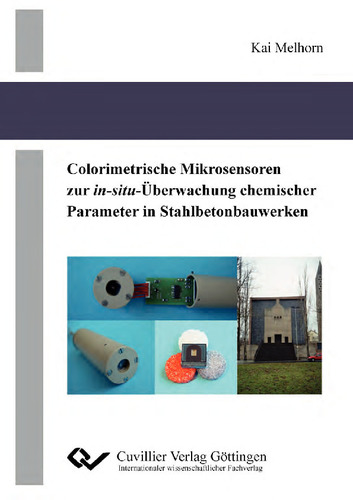
For several decades, a trend has been emerging in the construction industry that is lending ever greater importance to the topic of structural health monitoring (SHM). The current building stock (2000) in Germany amounts to a value of approximately 50 trillion euros. Fewer and fewer investments are being made in new buildings, while ever greater costs arise from damage to older buildings. In this context, the costs are initially low in the first years after commissioning. Regular maintenance and inspection intervals prevent major damage and document the condition of the structure. If maintenance and inspection work is well planned and executed, high costs for repairs can be avoided. Problems arise, however, when the type of use changes, unforeseeable damage occurs, or the design turns out to have been fundamentally inadequate. Collaborative Research Centre 477 (SFB 477), entitled “Ensuring the serviceability of structures by means of innovative structural health monitoring”, has been funded by the German Research Foundation (DFG) at the Technische Universität Braunschweig since 1998 and has set itself the goal of counteracting the ever-growing problems in the construction industry. To this end, the research was divided into four sub-areas in order to enable a holistic consideration of the problem and to develop possible solutions. In the area of “Methods and strategies for structural health monitoring”, theoretical investigations were carried out. In a second step, these findings were to be implemented with the aid of “adaptive models”. Furthermore, it was part of the concept to develop sensor technologies for structural health monitoring with which measurement data can be collected in practical applications (“Measurement technology – development and adaptation”). Finally, all of the aforementioned sub-areas were to be brought together through “Testing on structures”.
| ISBN-13 (Printausgabe) | 3869557206 |
| ISBN-13 (Hard Copy) | 9783869557205 |
| ISBN-13 (eBook) | 9783736937208 |
| Final Book Format | A5 |
| Language | German |
| Page Number | 156 |
| Lamination of Cover | glossy |
| Edition | 1 Aufl. |
| Volume | 0 |
| Publication Place | Göttingen |
| Place of Dissertation | TU Braunschweig |
| Publication Date | 2011-04-28 |
| General Categorization | Dissertation |
| Departments |
Engineering
Electrical engineering |


