
Cuvillier Verlag GmbH



| Departments | |
|---|---|
| Book Series (99) |
1415
|
| Nachhaltigkeit |
3
|
| Gesundheitswesen |
3
|
| Humanities |
2410
|
| Natural Sciences |
5428
|
| Engineering |
1820
|
| Engineering | 292 |
| Mechanical and process engineering | 872 |
| Electrical engineering | 699 |
| Mining and metallurgy | 30 |
| Architecture and civil engineering | 76 |
| Common |
97
|
|
Leitlinien Unfallchirurgie
5. Auflage bestellen |
|
Advanced Search
Untersuchung von Ejektor-Kälteanlagen beim Einsatz in tropischen Gebieten (English shop)
Ricardo Fiorenzano de Albuquerque (Author)Preview
Table of Contents, Datei (39 KB)
Extract, Datei (930 KB)
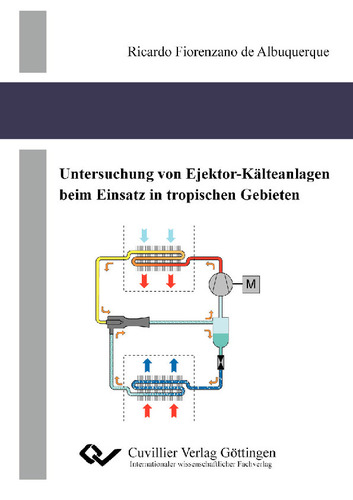
As a consequence of global warming, the environmentally harmful refrigerants used to date are to be replaced by more environmentally friendly refrigerants. In tropical applications, the CFC R12 or the partially halogenated HCFC R22 is still frequently used today. More recent systems now employ the HFC R134a or the HFC mixture R407C, which consists largely of R134a. The use of an ejector instead of the conventional expansion valve makes it possible, depending on the prevailing boundary conditions, to improve the overall efficiency of refrigeration cycles and heat pumps.
Within the framework of the present work, possible fields of application for ejectors in refrigeration cycles in tropical regions are investigated in a first step and the possible COP improvement is estimated.
In a second step, theoretical, experimental and numerical results of the investigation of a CO2 ejector refrigeration cycle are presented for the first time for the promising application in commercial refrigeration in tropical regions. The losses that occur during the throttling of the refrigerant in conventional systems are to be reduced with the aid of the ejector.
The main objective of the investigations is to demonstrate the possible COP improvement of a CO2 refrigeration cycle using an ejector instead of a throttling device in tropical regions. The application scenario investigated describes refrigeration technology using the example of refrigerated display cabinets for medium-temperature refrigeration in Recife, Brazil. For this purpose, an already existing CO2 ejector test rig is adapted to tropical boundary conditions. The test rig is thus intended to permit the setting of boundary conditions and capacities that are relevant for tropical regions. With the aid of the experimental investigations, empirical correlations for the mass flow ratio and for the ejector efficiency as a function of physical parameters at the inlet and outlet of the ejector are established for the first time. Cycle simulations are carried out for freezer cabinets in the field of medium-temperature refrigeration and compared with the results for conventional refrigerants.
| ISBN-13 (Printausgabe) | 3869557257 |
| ISBN-13 (Hard Copy) | 9783869557250 |
| ISBN-13 (eBook) | 9783736937253 |
| Final Book Format | A5 |
| Language | German |
| Page Number | 124 |
| Lamination of Cover | matt |
| Edition | 1 Aufl. |
| Volume | 0 |
| Publication Place | Göttingen |
| Place of Dissertation | TU Braunschweig |
| Publication Date | 2011-04-18 |
| General Categorization | Dissertation |
| Departments |
Mechanical and process engineering
|


