
Cuvillier Verlag GmbH



| Departments | |
|---|---|
| Book Series (99) |
1415
|
| Nachhaltigkeit |
3
|
| Gesundheitswesen |
3
|
| Humanities |
2412
|
| Natural Sciences |
5430
|
| Mathematics | 230 |
| Informatics | 320 |
| Physics | 982 |
| Chemistry | 1371 |
| Geosciences | 131 |
| Human medicine | 246 |
| Stomatology | 10 |
| Veterinary medicine | 112 |
| Pharmacy | 147 |
| Biology | 837 |
| Biochemistry, molecular biology, gene technology | 121 |
| Biophysics | 25 |
| Domestic and nutritional science | 45 |
| Agricultural science | 1006 |
| Forest science | 201 |
| Horticultural science | 20 |
| Environmental research, ecology and landscape conservation | 149 |
| Engineering |
1821
|
| Common |
97
|
|
Leitlinien Unfallchirurgie
5. Auflage bestellen |
|
Advanced Search
Synthese und Charakterisierung neuartiger binärer Molkülverbindungen schwerer Hauptgruppenelemente (English shop)
Stephan Traut (Author)Preview
Table of Contents, Datei (54 KB)
Extract, Datei (230 KB)
Despite their very similar electronegativities, binary molecular compounds, especially of the heavier homologues of groups 14–16, are very rare. Besides the purely academic interest in such cluster and cage compounds, there is also the possibility of applying them as precursors for the preparation of solid phases by modern methods such as the MOCVD or the sol-gel process, for example in the semiconductor industry or in the preparation of thermoelectric materials.
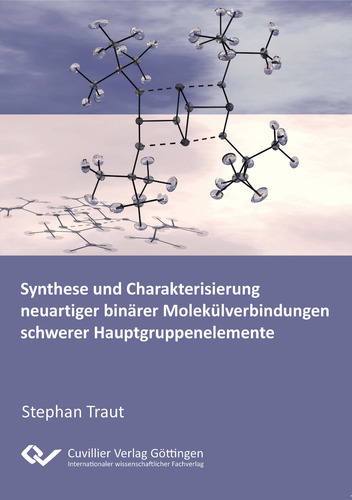
In the first part of this work, investigations of compounds of the elements of groups 14 and 15 were carried out. The Brønsted acid-base reaction of a primary silylpnictogen with the silylamides of the metals tin and lead proved successful. Heterocubane structures of the form M4E4 (M = Sn, Pb; E = P, As) could be obtained using both the tBu2PhSi and the (Me3Si)3Si group. In addition to the P- and As-bridged compounds of tin and lead, the synthesis and structural characterisation of a binary molecular compound of the element combination Pb/Sb was achieved for the first time. The reaction of iPr3SiSb(SiMe3)2 with PbCl2 in diethyl ether leads to the cage compound [(iPr3SiSb)6Pb4].
Following on from the successful synthesis of binary molecular compounds from element combinations of groups 14 and 15, the next part of this work examined whether interpnictogen compounds can also be obtained. The preparation of cyclic molecular compounds with an EBi2Cl ring (E = P, As) and an additional exocyclic chlorine atom as a structural motif was achieved. Furthermore, the dimerisation product [As(BiCH(SiMe3)2Cl)2]2 could be isolated, in which an As2 unit is formed with the formal elimination of disilane.
The last part of this work deals with the synthesis of silyltelluro-bridged main group metal compounds. The tBu2PhSi group had already proved successful in the pnictogen-bridged molecular compounds. Therefore, investigations of the reaction behaviour of tBu2PhSiTeSiMe3 towards the metal chlorides of the heavy main group metals were carried out. A whole series of compounds of the element combinations M/Te (M = Sn, Pb, Bi) could be prepared. The unusual Sn/Te compound [{(Me3Si)3SiTe}4Te2Sn4] can already be regarded as an intermediate on the way from the molecule to the binary phase.
The compound [(tBu2PhSiTe)4Pb2] furthermore represents the first example of a binary molecular compound with a Pb–Te bond to be characterised by single-crystal structure analysis.
| ISBN-13 (Printausgabe) | 3869557044 |
| ISBN-13 (Hard Copy) | 9783869557045 |
| ISBN-13 (eBook) | 9783736937048 |
| Language | German |
| Page Number | 162 |
| Edition | 1 Aufl. |
| Volume | 0 |
| Publication Place | Göttingen |
| Place of Dissertation | Karlsruhe |
| Publication Date | 2011-04-11 |
| General Categorization | Dissertation |
| Departments |
Chemistry
|
| Keywords | Clusters, lead, antimony, tellurium, arsenic |


