
Cuvillier Verlag GmbH



| Departments | |
|---|---|
| Book Series (99) |
1415
|
| Nachhaltigkeit |
3
|
| Gesundheitswesen |
3
|
| Humanities |
2412
|
| Natural Sciences |
5430
|
| Mathematics | 230 |
| Informatics | 320 |
| Physics | 982 |
| Chemistry | 1371 |
| Geosciences | 131 |
| Human medicine | 246 |
| Stomatology | 10 |
| Veterinary medicine | 112 |
| Pharmacy | 147 |
| Biology | 837 |
| Biochemistry, molecular biology, gene technology | 121 |
| Biophysics | 25 |
| Domestic and nutritional science | 45 |
| Agricultural science | 1006 |
| Forest science | 201 |
| Horticultural science | 20 |
| Environmental research, ecology and landscape conservation | 149 |
| Engineering |
1821
|
| Common |
97
|
|
Leitlinien Unfallchirurgie
5. Auflage bestellen |
|
Advanced Search
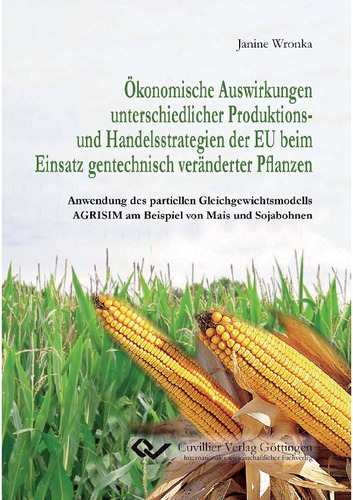
Ökonomische Auswirkungen unterschiedlicher Produktions- und Handelsstrategien der EU beim Einsatz gentechnisch veränderter Pflanzen (English shop)
Anwendung des partiellen Gleichgewichtsmodells AGRISIM am Beispiel von Mais und Sojabohnen
Janine Wronka (Author)Preview
Table of Contents, Datei (67 KB)
Extract, Datei (240 KB)
The essential substantive aim of the present study was to examine the economic effects both of the status quo policy and of other alternative EU policies in response to the increasing use of green biotechnology in other regions, and to compare these with one another in welfare-economic terms. In this way, the best policy alternative for the EU from a welfare-economic perspective was ultimately to be identified, but it was also to be assessed which of the various policy options carries the highest potential for political conflict in international trade. For this purpose the partial equilibrium model AGRISIM was used, from which the methodological objective of this study was simultaneously derived. It consisted in modelling both technology adoption and the different production and trade strategies adequately with AGRISIM.
To this end, five different scenarios were formulated, with an expansion of transgenic cultivation areas in Argentina, Brazil and the USA assumed as a constant component of all scenarios. The assumed EU policies comprised:
(1) No reaction (“status quo”)
(2) Tightening of import restrictions (“import ban”)
(3) Accelerated approval practice for imports (“import authorisation”)
(4) Cultivation of genetically modified maize and soybeans (“GM cultivation”)
(5) In addition to (4), a negative shift in the non-agricultural demand for maize and in the feed demand for maize, soybeans and soybean meal (“demand decline”)
The simulation results showed that, from a welfare-economic perspective, it is best for the EU likewise to adopt the new technology, since it is above all the regions in which GM crops are cultivated that benefit. However, the analysis also showed that preference-related declines in demand can clearly counteract and overcompensate this positive effect. Alongside the “demand decline” scenario, the second scenario, “import ban”, represents the one with the most severe welfare-economic losses for the adopting regions and an associated high potential for trade conflicts.
| ISBN-13 (Printausgabe) | 3954040719 |
| ISBN-13 (Hard Copy) | 9783954040711 |
| ISBN-13 (eBook) | 9783736940710 |
| Final Book Format | A5 |
| Language | German |
| Page Number | 294 |
| Lamination of Cover | glossy |
| Edition | 1 Aufl. |
| Volume | 0 |
| Publication Place | Göttingen |
| Place of Dissertation | Gießen |
| Publication Date | 2012-04-16 |
| General Categorization | Dissertation |
| Departments |
Agricultural science
|
| Keywords | Agricultural economics, home economics and nutrition science, genetically modified crops, partial equilibrium model, economics and social sciences of agriculture |


