
Cuvillier Verlag GmbH



| Departments | |
|---|---|
| Book Series (99) |
1415
|
| Nachhaltigkeit |
3
|
| Gesundheitswesen |
3
|
| Humanities |
2411
|
| Natural Sciences |
5429
|
| Mathematics | 230 |
| Informatics | 320 |
| Physics | 982 |
| Chemistry | 1371 |
| Geosciences | 131 |
| Human medicine | 246 |
| Stomatology | 10 |
| Veterinary medicine | 112 |
| Pharmacy | 147 |
| Biology | 837 |
| Biochemistry, molecular biology, gene technology | 121 |
| Biophysics | 25 |
| Domestic and nutritional science | 45 |
| Agricultural science | 1005 |
| Forest science | 201 |
| Horticultural science | 20 |
| Environmental research, ecology and landscape conservation | 148 |
| Engineering |
1821
|
| Common |
97
|
|
Leitlinien Unfallchirurgie
5. Auflage bestellen |
|
Advanced Search
Verbesserung der Dokumentation von Anforderungen auf Basis von Erfahrungen und Heuristiken (English shop)
Eric Knauss (Author)Preview
Table of Contents, Datei (43 KB)
Extract, Datei (130 KB)
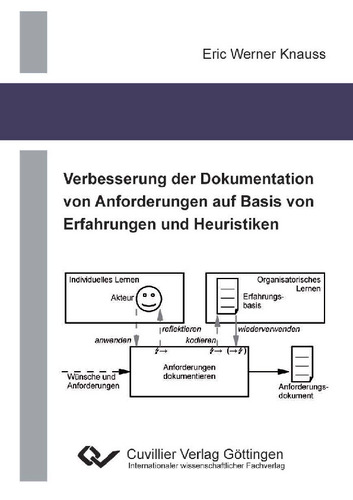
Even 40 years after the software crisis, organisations still struggle to deliver working software that meets customer requirements at sufficient quality. To a considerable extent this is due to deficient requirements engineering: if important aspects of the requirements are never clarified or are even misunderstood, open questions cause developers to be held up while clarifying them, or to close the gaps with assumptions of their own. Both can lead to late, fundamental changes, considerable additional effort and, in the worst case, to a product that is useless to the customer. In this way projects fail, are delayed, or significantly exceed their budget. Systematic and precise documentation of requirements helps, because it requires an intensive analysis of the requirements. In this way hidden contradictions can often be discovered that would otherwise only have become apparent during implementation or commissioning. Good requirements documentation makes it easier for quality managers to check whether all requirements have been met. Project managers estimate effort and monitor progress on the basis of documented requirements. Above all, good requirements documentation allows developers to concentrate on implementation instead of clarifying gaps with the customer – a task for which they are usually not trained. Despite the key role of requirements, requirements engineering is often neglected. Customers want to see results as quickly as possible and managers want to start creating the solution. Clarifying the task is too rarely seen as part of delivering the solution. Shorter release cycles and time-to-market create additional time pressure. Organisations have to document the requirements of ever more complex systems at high quality under great time pressure and with limited resources. Experience is one of the most important success factors for this goal. Many organisations therefore fall back on experienced external consultants, or have their experience and maturity formally assessed and improved.
This thesis presents a systematic approach showing how organisations can make better use of and extend existing experience with their established document and process models. To this end, it examines how computers can support the creation of natural-language requirements documents, which are inaccessible to established methods such as model checking or simulation. No particular document or process model is presupposed.
The thesis demonstrates a correlation between the quality of requirements documents and project success: projects with poor requirements fail more often. In most cases there are syntactic indicators for content-related problems in the requirements. Computers are able to exploit these indicators automatically and to help the analyst, by means of appropriate hints, to identify and remedy possible content-related problems. The concept of automatically exploiting syntactic indicators in order to provide a helpful hint is referred to in this thesis as heuristic critique. Heuristic critiques make it possible to represent an organisation’s experience and are a way of applying experience in a computer-based manner to the documentation of requirements. In this way relevant experience can be efficiently found, activated and supplemented with new experience. The thesis sets out the most important properties of such experience-based requirements engineering tools. Each of these properties is evaluated empirically.
The contributions of this dissertation are i) a conceptual model of the relationship between computer-based analysis of natural-language requirements and experience management, ii) a strategy for the empirical investigation of this relationship and iii) important data points on the potential of this approach.
| ISBN-13 (Printausgabe) | 3869555939 |
| ISBN-13 (Hard Copy) | 9783869555935 |
| ISBN-13 (eBook) | 9783736935938 |
| Final Book Format | A5 |
| Language | German |
| Page Number | 284 |
| Lamination of Cover | glossy |
| Edition | 1 Aufl. |
| Volume | 0 |
| Publication Place | Göttingen |
| Place of Dissertation | Universität Hannover |
| Publication Date | 2010-12-16 |
| General Categorization | Dissertation |
| Departments |
Informatics
|
| Keywords | Requirements Engineering, experience management, heuristic critiques |


