
Cuvillier Verlag GmbH



| Departments | |
|---|---|
| Book Series (99) |
1415
|
| Nachhaltigkeit |
3
|
| Gesundheitswesen |
3
|
| Humanities |
2412
|
| Medienwissenschaften | 17 |
| Theology | 57 |
| Philosophy | 103 |
| Law | 430 |
| Economics | 863 |
| Social sciences | 423 |
| Sports science | 48 |
| Psychology | 233 |
| Educational science | 190 |
| History | 194 |
| Art | 111 |
| Cultural studies | 168 |
| Literary studies | 119 |
| Linguistics | 91 |
| Natural Sciences |
5430
|
| Engineering |
1821
|
| Common |
97
|
|
Leitlinien Unfallchirurgie
5. Auflage bestellen |
|
Advanced Search
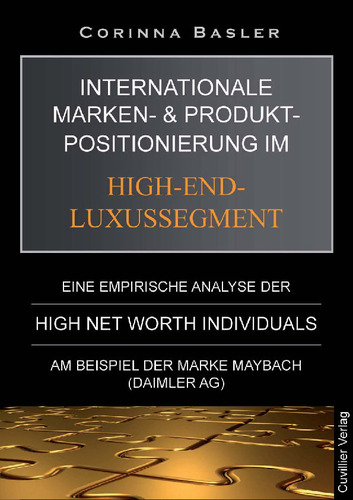
Internationale Marken- und Produktpositionierung im High-End-Luxussegment (English shop)
Eine empirische Analyse der High Net Worth Individuals am Beispiel der Marke Maybach (Daimler AG)
Corinna Basler (Author)Preview
Table of Contents, Datei (180 KB)
Extract, Datei (110 KB)
This research study represents the first valid high-end luxury segment study at an international level to have been conducted empirically on this scale. Almost 250 “High Net Worth Individuals” (HNWI) in the core markets of the Middle East, Asia, the USA and Europe were surveyed about their purchasing behaviour in personal, structured interviews. The acceptance rate of the study was over 97% of respondents. A distinction was made between “customers” (of the Maybach brand) and “non-customers” (HNWI drivers of competitor vehicles). Contacts were established on the basis of the customer database (Daimler AG), international automotive trade fairs (Shanghai etc.), events and dealer cooperations (Dubai etc.). The objective was to analyse brand loyalty as well as to identify purchase intention – in each case clustered for American, European, Asian and Arab luxury cultures. Purchasing behaviour was divided into “rational” factors (price, product, dealer/service and society-related) and “hedonistic” factors (based on brand personality) and analysed at the level of success. The “Partial Least Squares” (PLS) methodology of causal analysis was employed. With this statistical method for the valid investigation of causal-analytical relationships in small samples, the results are transferable to the luxury segment. Brand personality was measured in an international context using the “Brand Personality Scale” (BPS) developed by Jennifer Aaker (Stanford University, USA). Operational, tactical and strategic action scenarios were developed for each core market. At the international level, the hypotheses on brand identification could be confirmed, together with the significance of branding as a central management task.
The relationships between product, price, dealer and luxury involvement are strongly market-dependent. Recommendations are given for global as well as market-specific communication guidelines. The qualitative customer feedback allows the creation of idea pools (design, product management) and recommendations for luxury brand cooperations. Furthermore, synergy effects for the Daimler AG brand portfolio were demonstrated. This research study provides, for the first time, a comprehensive set of measurement instruments as an evaluation tool for brand controlling, for customer satisfaction analyses and positioning assessments of brands and products in the luxury segment.
| ISBN-13 (Printausgabe) | 3869555203 |
| ISBN-13 (Hard Copy) | 9783869555201 |
| ISBN-13 (eBook) | 9783736935204 |
| Language | German |
| Page Number | 284 |
| Edition | 1 Aufl. |
| Volume | 0 |
| Publication Place | Göttingen |
| Place of Dissertation | Universität Mainz |
| Publication Date | 2010-12-12 |
| General Categorization | Dissertation |
| Departments |
Economics
|
| Keywords | Maybach, Daimler AG, High Net Worth Individuals, luxury, automobile, brand personality |


