
Cuvillier Verlag GmbH



| Departments | |
|---|---|
| Book Series (99) |
1415
|
| Nachhaltigkeit |
3
|
| Gesundheitswesen |
3
|
| Humanities |
2412
|
| Natural Sciences |
5430
|
| Mathematics | 230 |
| Informatics | 320 |
| Physics | 982 |
| Chemistry | 1371 |
| Geosciences | 131 |
| Human medicine | 246 |
| Stomatology | 10 |
| Veterinary medicine | 112 |
| Pharmacy | 147 |
| Biology | 837 |
| Biochemistry, molecular biology, gene technology | 121 |
| Biophysics | 25 |
| Domestic and nutritional science | 45 |
| Agricultural science | 1006 |
| Forest science | 201 |
| Horticultural science | 20 |
| Environmental research, ecology and landscape conservation | 149 |
| Engineering |
1821
|
| Common |
97
|
|
Leitlinien Unfallchirurgie
5. Auflage bestellen |
|
Advanced Search
Genetische und molekulare Untersuchungen antinutritiver phenolischer Inhaltsstoffe (Tannine) der Rapssaat (Brassica napus L.) (English shop)
Florin Daniel Lipsa (Author)Preview
Table of Contents, Datei (50 KB)
Extract, Datei (640 KB)
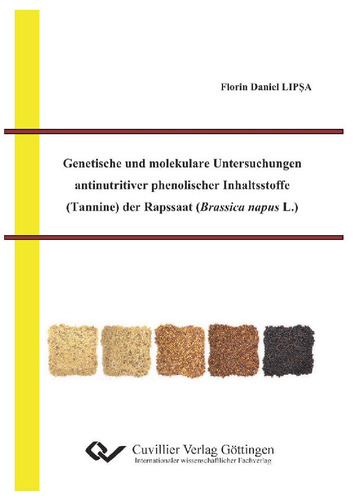
The essential aim of this work was to carry out genetic and chemical investigations of antinutritive phenolic compounds in rapeseed, mainly condensed tannins. The purpose was to determine possible relationships between seed colour and phenolic substances with a view to improving the quality of rapeseed meal. The doubled haploid (DH) winter oilseed rape population YE2, comprising 166 DH lines, was available as investigation material. Using 141 AFLP and 50 SSR markers, a genetic map was developed for the DH population, comprising 19 linkage groups with a total genetic length of 1171 cM. The rather weak correlation between seed colour and proanthocyanidin content leads to the conclusion that yellow seededness alone cannot be used as a selection marker for a reduction of proanthocyanidin or total flavonoid content. Using the HPLC measurements of the DH population YE2, relevant QTL for the various flavonoid components and for total flavonoids could likewise be detected. In addition to loci that co-localise with significant QTL for seed colour in this cross, various QTL could also be localised that are presumably associated with colourless flavonoids and therefore, independently of seed colour, have a nutritionally relevant influence on flavonoid composition. On chromosome N9, two loci for F1PA2 (sinapoylglucose) and F1PA3 co-localise with the major QTL for seed colour, together with further QTL for ADF, NDF and ADL contents as well as a QTL with a minor effect on flavonoid content. With regard to breeding for improved rapeseed meal quality, this result is significant, since it demonstrates an association between seed coat thickness and the contents of phenolic acids and other antinutritive substances. Through marker-assisted selection for this locus, a substantial reduction of the contents of phenolic acids and fibre components in rapeseed meal could possibly be achieved independently of seed colour. The results of HPLC analyses for mono- and oligomeric PAs indicate that the rapeseed meal extracts do not contain monomeric proanthocyanidins in detectable amounts. Interestingly, in some dark-seeded DH lines it was found that the seed contents of oligomeric PAs were very low and thus comparable with the contents in yellow seeds. These observations confirm the existence of genetic variation for seed cell wall thickness and associated components, which influence seed colour and rapeseed meal quality in dark-seeded B. napus forms. These results show that a large variation for phenolic substances exists in dark-seeded lines of the DH population. Thus, selection progress with respect to meal quality can also be expected independently of seed colour. Because of its role in the regulation of seed coat development as well as flavonoid biosynthesis, tt1 is an important candidate gene for seed colour and associated meal quality traits in oilseed rape. The preliminary QTL and segregation data for phenolic compounds suggest that the inheritance of these traits differs in different B. napus material, whereby, however, a single dominant gene plays a major role with respect to the reduction of some constituents. On chromosome N11, highly significant QTL for F1PA1, F1PA2, flavonoid and proanthocyanidin contents could be localised at the same position as the SSR marker tt1_1. Furthermore, QTL for seed colour, oil, F2PA2, F2PA3 and F3PA4 contents are also found at varying distances from 4 cM to 12 cM. This indicates that the SSR marker could be linked with a copy of the gene tt1 in the DH population YE2. From the mapping position of the marker, a weak association with seed colour in B. napus can be inferred, since no direct linkage with the seed colour QTL on chromosome N11 was detectable. The identical position of the tt1_1 marker with the aforementioned QTL points to a possible direct involvement of the tt1 gene in the formation of the endothelium cells and an indirect influence of the gene product on the accumulation of proanthocyanidins. The results of this study form the basis for marker-assisted breeding to produce light-seeded winter oilseed rape cultivars with improved meal quality. This is relevant both with regard to the use of the press residue as animal feed and as a basis for obtaining high-quality protein isolates and concentrates for animal and human nutrition. The molecular markers closely linked to seed colour and phenolic compounds that were identified in this study can represent valuable tools for breeding new light- or yellow-seeded genotypes with reduced contents of antinutritive substances.
| ISBN-13 (Printausgabe) | 3869555408 |
| ISBN-13 (Hard Copy) | 9783869555409 |
| ISBN-13 (eBook) | 9783736935402 |
| Language | German |
| Page Number | 144 |
| Edition | 1 Aufl. |
| Volume | 0 |
| Publication Place | Göttingen |
| Place of Dissertation | Universität Giessen |
| Publication Date | 2010-11-11 |
| General Categorization | Dissertation |
| Departments |
Agricultural science
|
| Keywords | BRASSICA NAPUS, TANNINS, HPLC, QTL |


