
Cuvillier Verlag GmbH



| Departments | |
|---|---|
| Book Series (99) |
1415
|
| Nachhaltigkeit |
3
|
| Gesundheitswesen |
3
|
| Humanities |
2412
|
| Medienwissenschaften | 17 |
| Theology | 57 |
| Philosophy | 103 |
| Law | 430 |
| Economics | 863 |
| Social sciences | 423 |
| Sports science | 48 |
| Psychology | 233 |
| Educational science | 190 |
| History | 194 |
| Art | 111 |
| Cultural studies | 168 |
| Literary studies | 119 |
| Linguistics | 91 |
| Natural Sciences |
5430
|
| Engineering |
1821
|
| Common |
97
|
|
Leitlinien Unfallchirurgie
5. Auflage bestellen |
|
Advanced Search
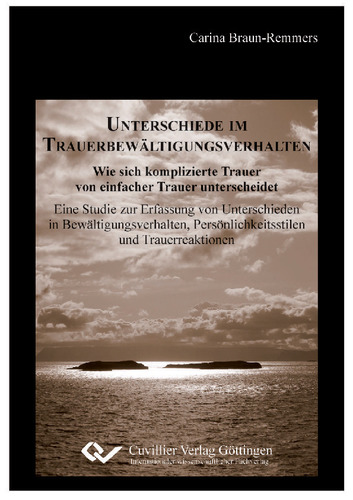
Unterschiede im Trauerbewältigungsverhalten (English shop)
Wie sich komplizierte Trauer von einfacher Trauer unterscheidet: Eine Studie zur Erfassung von Unterschieden in Persönlichkeitsstilen und Trauerreaktionen Bewältigungsverhalten, Persönlichkeitsstilen und Trauerreaktionen
Carina Braun-Remmers (Author)Preview
Table of Contents, Datei (70 KB)
Extract, Datei (110 KB)
The death of a person close to us is, for most people, an unavoidable event that constitutes a more or less profound turning point in one’s own life. Coping with the death of a spouse or life partner in particular represents a major challenge for most people. Grief is regarded in this context as a reaction to the loss of a close person, with generally normative and predictable consequences. Despite the painful and long-lasting intensity of feelings of grief, most people manage to cope with and integrate their loss. For approximately 20–40 % of the bereaved, however, this is not the case. Even many months later they still suffer from severe grief reactions that lead to impairments in many areas of life. Accepted and standardised criteria for the so-called complicated grief reaction have, however, been lacking to date. The aim of the study was therefore to identify and describe differences between persons with an uncomplicated grief reaction and persons with a complicated grief reaction. Furthermore, the Complicated Grief Module developed by Maercker and Langner (2002) was to be validated in a sample of persons who had lost their partner.
137 participants were recruited through contacts with pastoral carers, bereavement groups, self-help groups, grief counsellors and an advertisement in a daily newspaper, as well as from the participants of an earlier longitudinal study by Remmers (2009). In order to examine whether there are differences between the bereaved with regard to the coping strategies employed, the participants completed the Complicated Grief Module (KTM, Maercker & Langner, 2002) and modified scales of the COPE (Carver, Scheier & Weintraub, 1989) as well as questionnaires on personality variables and psychological and somatic symptoms, and were assigned on the basis of their KTM scores to the groups “complicated grief” or “uncomplicated grief”. On the basis of the KTM scores, 37 persons with complicated grief could be identified. All participants had to have lost their partner at least 12 months previously.
Correlations and one-way analyses of variance showed that the more pronounced the capacity for acceptance, the lower the grief reaction. The better a bereaved person succeeds in positively reappraising their loss, the lower the intensity of intrusion and depression. The capacity for acceptance and for positive reappraisal is considerably more pronounced in the uncomplicated bereaved than in the complicated bereaved. Optimism also appears to constitute a protective factor against the development of complicated grief. This could be attributable to the fact that optimists are considerably better able to accept the death of their partner than less optimistic people. With regard to personality traits, as expected, lower neuroticism, less fatalistic externality and more resilience and life satisfaction were found in the uncomplicated bereaved. Complicated bereaved persons also showed an increased degree of psychological distress as well as lower satisfaction with the previous partnership and a poorer state of health.
The results make clear that the KTM is a valid instrument for assessing the grief reaction following the loss of a partner. Over 50 % of the variance of the complicated grief reaction can be explained by the KTM scales. If only those variables are used which best predict the variables assessed in the Grief Module, then significantly less variance of complicated grief can be predicted in multiple regression analyses. For the predictability of the KTM scales, acceptance, optimism, neuroticism, grief reaction, depressiveness, intrusion and the time elapsed since the day of death proved to be the best variables for predicting the reactions assessed by the Complicated Grief Module.
There are differences between complicated and uncomplicated bereaved persons. The capacity to accept the loss of the partner and to reappraise it positively is significantly associated with a lower grief reaction, in particular fewer intrusions and less depression, and is, as expected, more pronounced in the uncomplicated bereaved than in the complicated bereaved. The differences in the KTM scales (intrusion, depressiveness, holding on to the presence of the deceased) as well as in essential areas of coping and personality between the grief groups argue for the existence of an independent construct of a complicated grief reaction. Inclusion as an independent diagnosis in the current classification systems could facilitate research into treatment approaches and make access to therapeutic help easier for those affected. The Complicated Grief Module by Maercker and Langner (2002) can provide diagnostic indications where a complicated grief reaction is suspected, which may facilitate treatment.
| ISBN-13 (Printausgabe) | 386955536X |
| ISBN-13 (Hard Copy) | 9783869555362 |
| ISBN-13 (eBook) | 9783736935365 |
| Final Book Format | A5 |
| Language | German |
| Page Number | 228 |
| Lamination of Cover | glossy |
| Edition | 1 Aufl. |
| Volume | 0 |
| Publication Place | Göttingen |
| Place of Dissertation | Universität Koblenz-Landau |
| Publication Date | 2010-11-04 |
| General Categorization | Dissertation |
| Departments |
Psychology
|
| Keywords | Grief, loss, bereavement research, coping strategies, acceptance, complicated grief, optimism, personality, coping, partnership, marriage |


