
Cuvillier Verlag GmbH



| Departments | |
|---|---|
| Book Series (99) |
1415
|
| Nachhaltigkeit |
3
|
| Gesundheitswesen |
3
|
| Humanities |
2412
|
| Natural Sciences |
5430
|
| Engineering |
1821
|
| Engineering | 292 |
| Mechanical and process engineering | 872 |
| Electrical engineering | 700 |
| Mining and metallurgy | 30 |
| Architecture and civil engineering | 76 |
| Common |
97
|
|
Leitlinien Unfallchirurgie
5. Auflage bestellen |
|
Advanced Search
Einsatz polykristalliner Nickelbasis-Legierungen zur Herstellung nanoporöser Membranen (English shop)
Fabian Schmitz (Author)Preview
Table of Contents, Datei (55 KB)
Extract, Datei (46 KB)
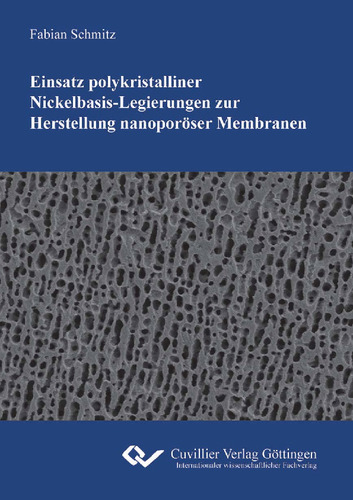
This work presents the alloy development and manufacturing process of nanoporous membranes based on polycrystalline nickel-base alloys; furthermore, the functional properties of the membranes thus obtained are investigated. For the specific requirements of this application, the alloys used had to be designed on the basis of established systems or through complete new development. On the one hand, modifications of the commercially available nickel-base alloy Nimonic 115 were employed. The composition of this alloy was changed in such a way that, in a first step, carbon was removed from the alloy in order to prevent carbide precipitation. The result is the alloy designated 115 NC, from which membranes were successfully produced. A further change in composition, in which molybdenum was replaced by vanadium, led to alloy 115 NCV. Here, the strength could additionally be reduced and thus the formability improved. On the other hand, a new alloy designated Ni-13Fe-8Al-4Ti was developed. Here, the simplest possible composition was chosen that yields an alloy with all the required properties. This system offers very good formability even at room temperature. The production of the nanoporous membranes is based on the phenomenon of directional coarsening of the γ’ phase in nickel-base alloys. For this to occur, plastic deformation of the sample and ageing at high temperatures are necessary. The use of a rolling process has proven to be very well suited in this context. Rolling routes leading to directional coarsening were therefore developed for the three newly developed alloys. In this process, relatively small plastic deformations are introduced into the rolling stock; subsequent ageing leads to coarsening of the γ’ precipitates. In order for fully aligned coarsening to take place and for the membranes to be produced, this sequence must be repeated several times. A chemical extraction process in the so-called MoO3 etchant is used as the final step of membrane production. After dissolution of the γ phase, a stable porous structure remains. This structure is permeable to gases, as could be shown in flow-through experiments. A comparison of membranes of different thicknesses showed that the flow rate decreases with increasing membrane thickness.
| ISBN-13 (Printausgabe) | 3869555238 |
| ISBN-13 (Hard Copy) | 9783869555232 |
| ISBN-13 (eBook) | 9783736935235 |
| Language | German |
| Page Number | 148 |
| Edition | 1 Aufl. |
| Volume | 0 |
| Publication Place | Göttingen |
| Place of Dissertation | TU Braunschweig |
| Publication Date | 2010-10-19 |
| General Categorization | Dissertation |
| Departments |
Mechanical and process engineering
|
| Keywords | Metallurgy, rolling mill and foundry technology, nickel-base alloys, filters, porous structures, alloy development |


