
Cuvillier Verlag GmbH



| Departments | |
|---|---|
| Book Series (99) |
1415
|
| Nachhaltigkeit |
3
|
| Gesundheitswesen |
3
|
| Humanities |
2412
|
| Medienwissenschaften | 17 |
| Theology | 57 |
| Philosophy | 103 |
| Law | 430 |
| Economics | 863 |
| Social sciences | 423 |
| Sports science | 48 |
| Psychology | 233 |
| Educational science | 190 |
| History | 194 |
| Art | 111 |
| Cultural studies | 168 |
| Literary studies | 119 |
| Linguistics | 91 |
| Natural Sciences |
5430
|
| Engineering |
1821
|
| Common |
97
|
|
Leitlinien Unfallchirurgie
5. Auflage bestellen |
|
Advanced Search
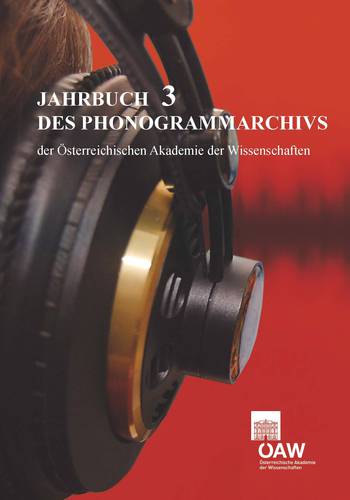
Jahrbuch des Phonogrammarchivs der Österreichischen Akademie der Wissenschaften (English shop)
3
Gerda Lechleitner (Editor)Christian Liebl (Editor)
Preview
Extract, PDF (620 KB)
Table of Contents, PDF (300 KB)
Yearbook 3 devotes three contributions to technical research and development in the audiovisual field, while two articles from contextualising research and one from the field of endangered cultures round off the picture in terms of synergies between audiovisual documentation in the field and archiving. This demonstrates the significance of the Phonogrammarchiv as a scholarly audiovisual archive and research institute at the Austrian Academy of Sciences in its key role with regard to new scholarly approaches and findings.
Using the example of the digitisation of a very early tape collection from Portugal, the expertise of the Phonogrammarchiv in the re-recording of historical sound carriers becomes apparent (N. Wallaszkovits). Making archive contents, metadata and also selected audio samples available online is one of the great challenges of the 21st century. The contribution by J. Spitzbart addresses particular technical problems – such as the transfer of metadata, search and sorting options and the adaptation of the various catalogue fields to the web portal – as well as ethical and moral concerns and copyright issues. Ten years ago, the archiving of scholarly video material was also begun. A review of the development of videography at the Phonogrammarchiv (F. Pavuza) shows how technical requirements and individual needs had to be reconciled, from which strategies for the future also emerge.
The chapter “Contextualisation” begins with an article on personal reflections on filming in ethnographic research (B. Engelbrecht). The focus of this contribution lies on a gain in knowledge through targeted feedback methods. A further facet of contextualisation opened up with the example of an extensive tape collection entrusted to the archive, from 15 years of field research among the Tamang in Nepal (1968–83). A. Höfer’s account provides valuable information on the genesis of the recordings, on their contents and on the retrospective handling of the research data by their creator.
The phenomenon of endangered cultures is addressed in the contribution on continuity and discontinuity in the music of northern Mozambique (A. Schmidhofer). The causes are manifold, and the changes perceptible today are explained in comparison with music documentation dating back more than 30 years.
The project report on the Greece field research (R.M. Brandl & B. Graf), a long-term documentation in Epirus and on Karpathos, likewise addresses changes and ruptures in musical practice. With a conference report by B. Brabec de Mori on the 19th Meeting of the ICTM Study Group on Historical Sources of Traditional Music and a review of Siegfried Tornow’s now third book on the language of the Burgenland Croats (G. Neweklowsky), the circle of research and interpretative possibilities of scholarly audiovisual sources is completed.
| ISBN-13 (Hard Copy) | 9783954041398 |
| ISBN-13 (eBook) | 9783736941397 |
| Final Book Format | A5 |
| Language | German |
| Page Number | 126 |
| Lamination of Cover | matt |
| Edition | 1. Aufl. |
| Publication Place | Göttingen |
| Publication Date | 2012-06-25 |
| General Categorization | Non-Fiction |
| Departments |
Art
Cultural studies Linguistics Literary studies Electrical engineering |


