
Cuvillier Verlag GmbH



| Departments | |
|---|---|
| Book Series (99) |
1415
|
| Nachhaltigkeit |
3
|
| Gesundheitswesen |
3
|
| Humanities |
2412
|
| Medienwissenschaften | 17 |
| Theology | 57 |
| Philosophy | 103 |
| Law | 430 |
| Economics | 863 |
| Social sciences | 423 |
| Sports science | 48 |
| Psychology | 233 |
| Educational science | 190 |
| History | 194 |
| Art | 111 |
| Cultural studies | 168 |
| Literary studies | 119 |
| Linguistics | 91 |
| Natural Sciences |
5430
|
| Engineering |
1821
|
| Common |
97
|
|
Leitlinien Unfallchirurgie
5. Auflage bestellen |
|
Advanced Search
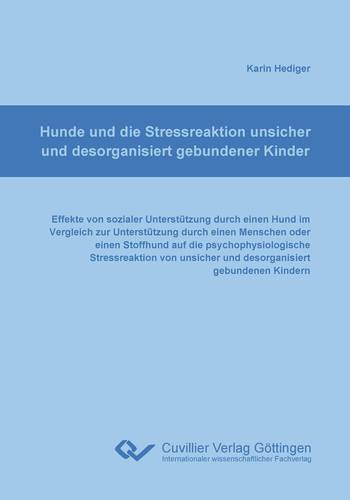
Hunde und die Stressreaktion unsicher und desorganisiert gebundener Kinder (English shop)
Effekte von sozialer Unterstützung durch einen Hund im Vergleich zur Unterstützung durch einen Menschen oder einen Stoffhund auf die psychophysiologische Stressreaktion von unsicher und desorganisiert gebundener Kinder
Karin Hediger (Author)Preview
Extract, PDF (190 KB)
Table of Contents, PDF (45 KB)
Insecurely and disorganised attached children lack the stress-protective effect of a secure attachment. They therefore respond to stressors with heightened physiological stress reactions. At the same time, owing to the transmission of attachment to new interpersonal relationships, they have difficulty accepting social support from other people and using it for stress regulation.
Relationships with animals can constitute attachments in the sense of attachment theory and appear to be independent of the already existing interpersonal attachment organisation. This could enable insecurely and disorganised attached children to accept the support of a dog and to use it for stress regulation, especially since research has shown that dogs have stress-reducing effects.
For these reasons, the present study investigated whether attachment to animals is independent of interpersonal attachment and to what extent insecurely or disorganised attached children (aged 9.2 ± 1.2 years) benefit during a laboratory stress test (“Trier Social Stress Test for Children”, TSST-C) from the support of a dog (N=25), a female student (N=15) or from the presence of a toy dog (N=14), and are able to use this to regulate the psychophysiological stress response (assessed via salivary cortisol and questionnaire).
It could be shown that the attachment quality of children’s relationships with animals is independent of the already existing interpersonal attachment patterns. With regard to the psychological response to the TSST-C, no difference was found between the study groups. The cortisol response, by contrast, was significantly lower in the dog condition than when the children were accompanied by a female student or a toy dog.
This shows that insecurely and disorganised attached children can develop secure attachments to animals and that, with regard to stress regulation, they benefit more from the support of a dog than from the support of a female student or a toy dog.
| ISBN-13 (Hard Copy) | 9783954041091 |
| ISBN-13 (eBook) | 9783736941090 |
| Final Book Format | A5 |
| Language | German |
| Page Number | 316 |
| Lamination of Cover | matt |
| Edition | 1. Aufl. |
| Publication Place | Göttingen |
| Place of Dissertation | Rostock |
| Publication Date | 2012-07-14 |
| General Categorization | Dissertation |
| Departments |
Psychology
Educational science |
| Keywords | Animal-assisted therapy / animal-assisted interventions, attachment/attachment patterns, stress, cortisol, social support, human-animal relationship, dog |


