
Cuvillier Verlag GmbH



| Departments | |
|---|---|
| Book Series (99) |
1415
|
| Nachhaltigkeit |
3
|
| Gesundheitswesen |
3
|
| Humanities |
2411
|
| Natural Sciences |
5430
|
| Mathematics | 230 |
| Informatics | 320 |
| Physics | 982 |
| Chemistry | 1371 |
| Geosciences | 131 |
| Human medicine | 246 |
| Stomatology | 10 |
| Veterinary medicine | 112 |
| Pharmacy | 147 |
| Biology | 837 |
| Biochemistry, molecular biology, gene technology | 121 |
| Biophysics | 25 |
| Domestic and nutritional science | 45 |
| Agricultural science | 1006 |
| Forest science | 201 |
| Horticultural science | 20 |
| Environmental research, ecology and landscape conservation | 149 |
| Engineering |
1821
|
| Common |
97
|
|
Leitlinien Unfallchirurgie
5. Auflage bestellen |
|
Advanced Search
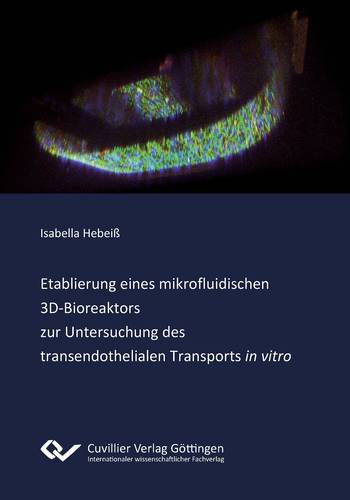
Etablierung eines mikrofluidischen 3D‐Bioreaktors zur Untersuchung des transendothelialen Transports "in vitro" (English shop)
Isabella Hebeiß (Author)Preview
Extract, PDF (1.2 MB)
Table of Contents, PDF (130 KB)
This work describes the successful development of a microfluidic bioreactor for studying the blood vessel system in vitro. The central element of the bioreactor is a curved, porous microchannel that represents the artificial blood vessel. The SMART technology used to fabricate the microchannels is a thermoforming process for processing thin polymer films that enables the thermoforming of already modified films.
As a preliminary step towards establishing the cultivation of endothelial cells in the porous microchannels, a new Boyden chamber system was developed which enables transendothelial transport through a porous, curved half-channel. By reproducing the radii of curvature of blood vessels in this half-channel, in vivo conditions can be mimicked. Human endothelial cells were successfully cultivated to confluence. A difference in morphology was observed between endothelial cells cultivated on flat surfaces as opposed to cells on curved surfaces.
By closing the porous half-channel by means of thermal bonding and equipping the microchannel with connectors for a pump system, a microfluidic system could be developed. This allows the investigation of the vascular system under shear stress conditions. The microchannel is surrounded by a second chamber, which can be used to collect transported substances but also to cultivate a co-culture. Initial co-culture experiments demonstrated successful cultivation of fibroblasts and human breast cancer cells in the adjacent compartment. Various responses of the endothelial cells in the microchannel to shear stress conditions could be demonstrated using the microfluidic bioreactor. Among others, the alignment of the cells in the direction of flow as well as a change in the actin cytoskeleton through the formation of stress fibers and an increased nitric oxide (NO) production were shown. Furthermore, the bioreactor could be successfully used to simulate an inflammatory response and the associated recruitment processes of immune cells. Confocal spinning disk microscopy enabled the direct visualisation of the rolling, adhesion and transmigration of the monocytes. The bioreactor found a further application in the investigation of the transendothelial transport of polycationic peptoids. To confirm the applicability of these peptoids in cell culture experiments, their influence on cell activity was investigated by means of a cytotoxicity assay. At the concentrations used, the peptoids showed no or only low cytotoxicity. Using confocal fluorescence microscopy, the successful uptake of the peptoids into endothelial cells could be demonstrated. Mechanistic investigations revealed the involvement of endocytic pathways in the uptake of the peptoids. The quantitative investigation of peptoid uptake into endothelial cells revealed an increased uptake of guanidinylated peptoids compared to their amine analogues, both for peptoids with aliphatic and with aromatic side chains.
The newly developed microfluidic bioreactor with the curved artificial blood vessel thus offers a platform for numerous investigations, both of the endothelium in its natural, curved form under fluidic conditions and of various transendothelial transport processes. By varying the channel geometries or the pores, the bioreactor can be optimally adapted to the respective requirements of the experiments.
| ISBN-13 (Hard Copy) | 9783954042005 |
| ISBN-13 (eBook) | 9783736942004 |
| Final Book Format | A5 |
| Language | German |
| Page Number | 182 |
| Lamination of Cover | glossy |
| Edition | 1. Aufl. |
| Publication Place | Göttingen |
| Place of Dissertation | Karlsruhe |
| Publication Date | 2012-10-19 |
| General Categorization | Dissertation |
| Departments |
Biochemistry, molecular biology, gene technology
|


