
Cuvillier Verlag GmbH



| Departments | |
|---|---|
| Book Series (99) |
1415
|
| Nachhaltigkeit |
3
|
| Gesundheitswesen |
3
|
| Humanities |
2411
|
| Natural Sciences |
5429
|
| Engineering |
1821
|
| Engineering | 292 |
| Mechanical and process engineering | 872 |
| Electrical engineering | 700 |
| Mining and metallurgy | 30 |
| Architecture and civil engineering | 76 |
| Common |
97
|
|
Leitlinien Unfallchirurgie
5. Auflage bestellen |
|
Advanced Search
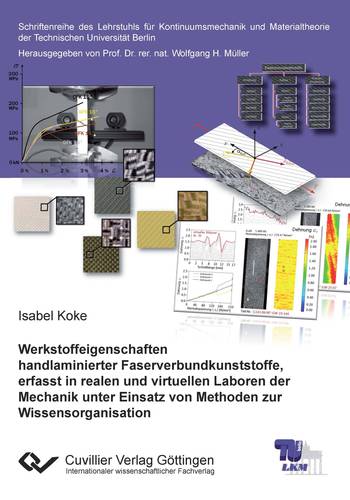
Werkstoffeigenschaften handlaminierter Faserverbundkunststoffe, erfasst in realen und virtuellen Laboren der Mechanik unter Einsatz von Methoden zur Wissensorganisation (Volume 6) (English shop)
Isabel Koke (Author)Preview
Extract, PDF (3.1 MB)
Table of Contents, PDF (39 KB)
Fibre-reinforced plastics are fascinating because of their enormous lightweight construction potential, which, however, they only realise fully when the fibres are arranged in accordance with the load profile. The composite is not created until the component is manufactured and, owing to its locally varying material behaviour and its layered, direction-dependent structure, exhibits highly complex material behaviour, which complicates the design of such a structure.
In this research work, an experimental methodology based on the principle of photogrammetry was developed and documented, by means of which the elastic material characteristics of the overall laminate that are essential for computational design can be determined. Fibre-reinforced plastics produced by hand lay-up, consisting of fibre fabrics embedded in an epoxy resin matrix, were investigated. The experimental results obtained using this method provide a comprehensive body of data for the four most common fibre materials examined – glass, carbon, aramid and basalt – which, compared with theoretical predictions, shows varying degrees of agreement depending on the material. Finally, an online teaching and learning platform with integrated virtual laboratories for engineering education was conceived and implemented, incorporating the insights gathered from experiment and laminate theory. The learning environment named E-MechLAB serves equally as a starting point for opening up the field of knowledge and as a reference work for in-depth study.
The general topic of this work is the mechanics of fibre-reinforced plastics, from both an experimental and a theoretical standpoint. Three aspects are brought together, which are elaborated in Chapters 2, 3 and 4.
Chapter 2, entitled “Mechanics and real laboratories – experimental determination of the elastic material properties of fibre-reinforced plastic composites using optical field measurement techniques”, describes the production of the fibre-reinforced materials by hand lay-up and the method of photogrammetry that was employed to determine the mechanical characteristics experimentally. Particular attention is paid to compiling the properties of the base materials, the measurement method of photogrammetry is outlined, and the test evaluation for determining the modulus of elasticity and shear modulus as well as the Poisson’s ratio for anisotropic materials according to DIN is described. The plastic (epoxy resin) was reinforced with aramid, basalt, glass and carbon fibre fabrics.
Chapter 3, “Theory for the laboratory – introduction to laminate theory and comparison with experiments”, primarily explains the fundamentals of laminate theory. Particular emphasis is placed on a presentation in the spirit of Rational Mechanics. The chapter is furthermore devoted to the comparison between experimental and theoretical results. Discrepancies that occasionally arise are identified and interpreted.
Chapter 4, “Mechanics and virtual laboratories – new teaching methods for a science rich in tradition”, goes beyond the content of a “regular” dissertation. Here it is successfully shown how the experimental and theoretical results of the preceding chapters can be prepared and presented in an appealing multimedia form in virtual laboratories for engineering education, for the layperson as well as for the advanced engineer working with fibre composite materials. Experiences from publicly funded projects are reported, teaching concepts are discussed and their implementation as e-learning content is demonstrated using a concrete example. In this context, particular mention should be made of the DVD accompanying the written dissertation, on which the virtual laboratories presented are available for practical use.
| ISBN-13 (Hard Copy) | 9783954040810 |
| ISBN-13 (eBook) | 9783736940819 |
| Final Book Format | A5 |
| Language | German |
| Page Number | 306 |
| Lamination of Cover | matt |
| Edition | 1. Aufl. |
| Book Series | Schriftenreihe des Lehrstuhls für Kontinuumsmechanik und Materialtheorie der Technischen Universität Berlin |
| Volume | 6 |
| Publication Place | Göttingen |
| Place of Dissertation | Berlin |
| Publication Date | 2012-08-22 |
| General Categorization | Dissertation |
| Departments |
Engineering
Technical mechanics Mechanical and process engineering Construction technology Manufacturing and production engineering |
| URL to External Homepage | http://www.hni.uni-paderborn.de/rtm/mitarbeiter/125327550900812/ |


