
Cuvillier Verlag GmbH



| Departments | |
|---|---|
| Book Series (99) |
1415
|
| Nachhaltigkeit |
3
|
| Gesundheitswesen |
3
|
| Humanities |
2415
|
| Natural Sciences |
5432
|
| Mathematics | 230 |
| Informatics | 320 |
| Physics | 982 |
| Chemistry | 1371 |
| Geosciences | 131 |
| Human medicine | 247 |
| Stomatology | 10 |
| Veterinary medicine | 112 |
| Pharmacy | 147 |
| Biology | 838 |
| Biochemistry, molecular biology, gene technology | 121 |
| Biophysics | 25 |
| Domestic and nutritional science | 45 |
| Agricultural science | 1006 |
| Forest science | 201 |
| Horticultural science | 20 |
| Environmental research, ecology and landscape conservation | 149 |
| Engineering |
1822
|
| Common |
97
|
|
Leitlinien Unfallchirurgie
5. Auflage bestellen |
|
Advanced Search
Sensorik-Marketing für Lebensmittel (English shop)
Tim Obermowe (Author)Preview
Extract, PDF (110 KB)
Table of Contents, PDF (21 KB)
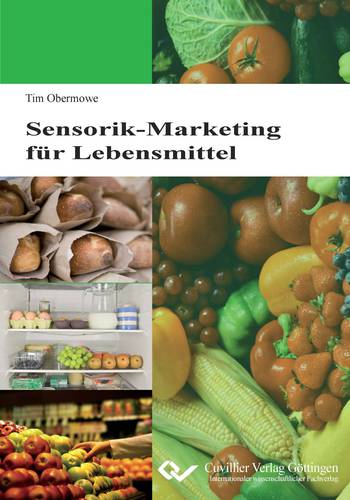
This dissertation set out to illuminate the potentials of taking sensory aspects into account for the marketing of food products. The focus lay on examining consumers’ perception of sensory characteristics in the consumption of food.
In summary, consumers’ considerable interest in sensory aspects and the resulting high relevance for food consumption can first of all be underlined. Many consumers desire information about the sensory perception and the associated experience of enjoyment that awaits them when eating foods and drinking beverages. Moreover, consumers appear to take pleasure in exchanging views on their experiences and expectations with regard to aspects such as taste or smell while eating and drinking, which can be corroborated in particular by the impressions gained in the course of the personal interviews. Against this background, the insight derived both from the findings of food consumption research (cf. KRONDL/LAU 1982; FURST ET AL. 1996; HUGHNER ET AL. 2007; MAX-RUBNER-INSTITUT 2008; STENZEL 2008) and from current trends in dietary behaviour (cf. KIRIG ET AL. 2011; ZÜHLSDORF/SPILLER 2012) can be confirmed, namely that sensory characteristics are of central importance in the purchase of food.
Furthermore, the results of the studies presented in this work, as well as the impressions gained during the conduct of the underlying surveys, have shown that the human senses are not necessarily a reliable instrument for assessing the quality of food. Thus, the evaluation of a product’s sensory characteristics may, depending on the situation and the influences that accompany it (e.g. a label or other information about the product), turn out markedly differently than under different preconditions, even though in qualitative terms it is the identical product. The insight that the perception of sensory characteristics can be substantially influenced not only by the actual chemically determined quality but also by the presentation of the product has already been confirmed by the findings of various studies (PLASSMANN ET AL. 2008; SIEGRIST/COUSIN 2009; FRANCHI 2012). This underlines the potentials that may arise from taking sensory aspects into account within marketing activities and in the product positioning of food.
That this potential has thus far not been fully exploited within the food industry is illustrated in particular by the discussions in the first part of this work. Using the example of the meat industry, it was pointed out that despite consumers’ willingness to pay a higher price for high-quality products (ALBERSMEIER ET AL. 2009), there are as yet virtually no approaches within the sector to advertise such a quality advantage on the basis of the products’ sensory characteristics. In addition, the example of the premium-enjoyment retail brand examined in the second article made clear that laying claim to premium quality by means of an elaborate marketing concept does not automatically and immediately lead to food being perceived by consumers on the same level as established gourmet products.
The potentials of sensory marketing could be demonstrated in the second part of this work particularly for the organic sector as well. Depending on their consumption intensity, consumers of organic food sometimes have a different approach to the topic of sensory perception and therefore place different demands on the marketing of the products. For instance, some organic customers (tending to be occasional and infrequent buyers) desire information on the taste quality of the products, whereas others (tending to be intensive buyers) consider labelling of sensory characteristics superfluous and prefer to rely on their own perception in this respect. It could further be shown that organic customers can be assigned to different consumer groups on the basis of their sensory preferences. Here, too, it became clear that the heterogeneous organic clientele places differing demands on the orientation of marketing and the associated use of sensory aspects. While for some consumers the uniqueness or distinctiveness of the products in the sense of a Core Organic Taste is formative for their sensory preferences, others rather desire a taste of organic products oriented towards the conventional mass-market standard. A further finding is that organically produced foods enjoy a high reputation among consumers with regard to their sensory characteristics. Thus it could be shown that labelling as an organic product has a positive effect on the perception of the products’ enjoyment quality.
| ISBN-13 (Hard Copy) | 9783954042562 |
| ISBN-13 (eBook) | 9783736942561 |
| Final Book Format | A5 |
| Language | German |
| Page Number | 240 |
| Lamination of Cover | matt |
| Edition | 1. Aufl. |
| Publication Place | Göttingen |
| Place of Dissertation | Göttingen |
| Publication Date | 2012-10-22 |
| General Categorization | Dissertation |
| Departments |
Agricultural science
|
| Keywords | Agricultural Economics and Social Sciences, sensory science, food marketing, enjoyment, gourmet, agricultural economics |


