
Cuvillier Verlag GmbH



| Departments | |
|---|---|
| Book Series (99) |
1415
|
| Nachhaltigkeit |
3
|
| Gesundheitswesen |
3
|
| Humanities |
2412
|
| Medienwissenschaften | 17 |
| Theology | 57 |
| Philosophy | 103 |
| Law | 430 |
| Economics | 863 |
| Social sciences | 423 |
| Sports science | 48 |
| Psychology | 233 |
| Educational science | 190 |
| History | 194 |
| Art | 111 |
| Cultural studies | 168 |
| Literary studies | 119 |
| Linguistics | 91 |
| Natural Sciences |
5430
|
| Engineering |
1821
|
| Common |
97
|
|
Leitlinien Unfallchirurgie
5. Auflage bestellen |
|
Advanced Search
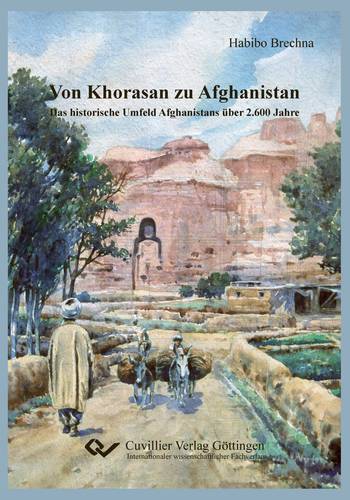
Von Khorasan zu Afghanistan (English shop)
Das historische Umfeld Afghanistans über 2.600 Jahren
Habibo Brechna (Author)Preview
Extract, PDF (810 KB)
Table of Contents, PDF (46 KB)
Afghanistan was and remains a beautiful country. It experienced a long period of glorious history spanning centuries. The common designation of the present-day territory was Khorasan. It attained its national identity in the 18th century under Ahmad Shah Baba. Afghanistan became the official name of the kingdom at the beginning of the 19th century. Although conquered by the Achaemenids, the Greeks, Alexander the Great, the equestrian peoples, the Arabs and the Turks, the indigenous population always knew how to absorb the culture of the conquerors and to add values of its own.
Today the Afghan people is a conglomerate of different ethnic groups fighting one another. The destruction of Khorasan culture proceeded in various stages: the Arabs, the Mongols and the Turco-Mongols destroyed various cultural cities; the religion of Zoroaster and Buddhism were eradicated. The last great fire temple, built by the Kushans, was razed by the Taliban, who also smashed the Buddhas.
This study shows that for more than 2,600 years Khorasan possessed a high culture which obliges us to preserve it rather than destroy it…
| ISBN-13 (Hard Copy) | 9783869555898 |
| ISBN-13 (eBook) | 9783736935891 |
| Final Book Format | B5 |
| Language | German |
| Page Number | 608 |
| Edition | 2. Aufl. |
| Publication Place | Göttingen |
| Publication Date | 2010-11-12 |
| General Categorization | Non-Fiction |
| Departments |
History
|


