
Cuvillier Verlag GmbH



| Departments | |
|---|---|
| Book Series (99) |
1415
|
| Nachhaltigkeit |
3
|
| Gesundheitswesen |
3
|
| Humanities |
2411
|
| Natural Sciences |
5429
|
| Mathematics | 230 |
| Informatics | 320 |
| Physics | 982 |
| Chemistry | 1371 |
| Geosciences | 131 |
| Human medicine | 246 |
| Stomatology | 10 |
| Veterinary medicine | 112 |
| Pharmacy | 147 |
| Biology | 837 |
| Biochemistry, molecular biology, gene technology | 121 |
| Biophysics | 25 |
| Domestic and nutritional science | 45 |
| Agricultural science | 1005 |
| Forest science | 201 |
| Horticultural science | 20 |
| Environmental research, ecology and landscape conservation | 148 |
| Engineering |
1821
|
| Common |
97
|
|
Leitlinien Unfallchirurgie
5. Auflage bestellen |
|
Advanced Search
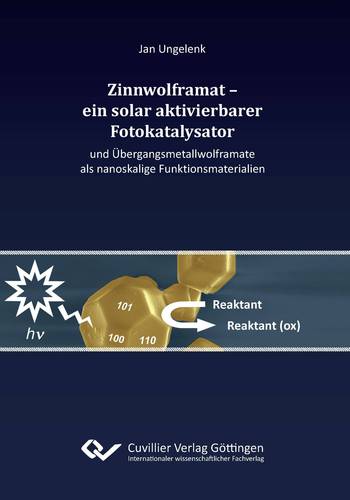
Zinnwolframat – ein solar aktivierbarer Fotokatalysator und Übergangsmetallwolframate als nanoskalige Funktionsmaterialien (English shop)
Jan Ungelenk (Author)Preview
Extract, PDF (270 KB)
Table of Contents, PDF (84 KB)
Photocatalysis enables the direct conversion of light energy into chemical energy. Attractive applications include the generation of hydrogen and the treatment of water by photodisinfection or the photocatalytic degradation of pollutants. The previous “gold standard” of photocatalysis, anatase titanium dioxide, is however limited to activation by UV light. There is great interest in new photocatalysts that can also be activated by longer-wavelength light: on the one hand, the natural solar spectrum could then be used efficiently as a light source. In addition, new applications open up in the field of medicine, such as the minimally invasive photodynamic therapy of tumours by irradiation with cell-friendly visible light.
In the present work, cubic tin tungstate, hitherto difficult to access, was prepared and optimised for use in photocatalysis. Thus, not only was one of the most active photocatalysts to date developed, but at the same time the complete development process was exemplarily depicted: beginning with (1) the identification and preparation of a suitable phase, (2) the optimisation of its material form as nanoparticles as well as faceted microcrystals, (3) the comprehensive characterisation of these materials, (4) the study and model-based description of external influencing factors, the work extends to (5) the testing of the application potential. In this context, among other things, a promising therapeutic success is demonstrated in the photodynamic treatment of tumours and metastases in animal as well as human tissue.
| ISBN-13 (Hard Copy) | 9783954044542 |
| ISBN-13 (eBook) | 9783736944541 |
| Final Book Format | A5 |
| Language | German |
| Page Number | 216 |
| Edition | 1. Aufl. |
| Publication Place | Göttingen |
| Place of Dissertation | Karlsruhe |
| Publication Date | 2013-07-02 |
| General Categorization | Dissertation |
| Departments |
Chemistry
|
| Keywords | Tin tungstate, photocatalyst, metal tungstate, nanoparticles, faceted microcrystals, photodynamic therapy, inorganic chemistry |


