
Cuvillier Verlag GmbH



| Departments | |
|---|---|
| Book Series (99) |
1415
|
| Nachhaltigkeit |
3
|
| Gesundheitswesen |
3
|
| Humanities |
2411
|
| Natural Sciences |
5430
|
| Mathematics | 230 |
| Informatics | 320 |
| Physics | 982 |
| Chemistry | 1371 |
| Geosciences | 131 |
| Human medicine | 246 |
| Stomatology | 10 |
| Veterinary medicine | 112 |
| Pharmacy | 147 |
| Biology | 837 |
| Biochemistry, molecular biology, gene technology | 121 |
| Biophysics | 25 |
| Domestic and nutritional science | 45 |
| Agricultural science | 1006 |
| Forest science | 201 |
| Horticultural science | 20 |
| Environmental research, ecology and landscape conservation | 149 |
| Engineering |
1821
|
| Common |
97
|
|
Leitlinien Unfallchirurgie
5. Auflage bestellen |
|
Advanced Search
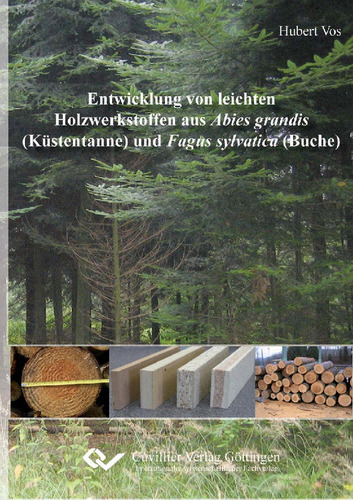
Entwicklung von leichten Holzwerkstoffen aus Abies grandis (Küstentanne) und Fagus sylvatica (Buche) (English shop)
Hubert Vos (Author)Preview
Table of Contents, Datei (51 KB)
Extract, Datei (71 KB)
Grand fir (Abies grandis (Douglas) Lindley), native to North America, is currently grown in Germany on an area of more than 10,000 hectares. It is one of the 14 non-native tree species in Germany that are of relevance on the German timber market. Its market significance, however, lies well behind that of Douglas fir, Japanese larch and hybrid poplar. The grand fir stands present in Germany, among them numerous stands from cultivation trials, have shown that this tree species possesses an enormous growth potential and a good capacity for ecological integration. Grand fir is thus described as the most productive coniferous species in Western Europe. Its light-coloured wood with an even texture exhibits physical and mechanical properties comparable to those of Norway spruce (Picea abies) and the native silver fir (Abies alba). Existing literature on the previous possible uses of grand fir wood refers to the North American region. There it is valued on account of its greater fibre length, its freedom from resin and its light-coloured, soft wood. These properties predestine its use in the American pulp and paper industry. The low specific gravity as well as the absence of odour in the dried state additionally make the wood highly sought after for interior applications, such as panelling and wood cladding. Furthermore, grand fir is used for the manufacture of crate wood. For the use of grand fir in the production of wood-based materials, by contrast, hardly any literature is available to date. Beyond the wood properties and possible uses of grand fir listed above, the wood is comparable to that of Norway spruce and silver fir with regard to machinability and drying properties. The situation is different in respect of glueability, since in this regard grand fir is convincing with excellent properties. This wood therefore possesses the best prerequisites for the manufacture of wood-based materials, in particular the production of particleboard, OSB and fibreboard.
| ISBN-13 (Printausgabe) | 3869554649 |
| ISBN-13 (Hard Copy) | 9783869554648 |
| ISBN-13 (eBook) | 9783736934641 |
| Final Book Format | A5 |
| Language | German |
| Page Number | 218 |
| Lamination of Cover | matt |
| Edition | 1 Aufl. |
| Volume | 0 |
| Publication Place | Göttingen |
| Place of Dissertation | Universität Göttingen |
| Publication Date | 2010-08-26 |
| General Categorization | Dissertation |
| Departments |
Forest science
|


