
Cuvillier Verlag GmbH



| Departments | |
|---|---|
| Book Series (99) |
1415
|
| Nachhaltigkeit |
3
|
| Gesundheitswesen |
3
|
| Humanities |
2412
|
| Natural Sciences |
5430
|
| Mathematics | 230 |
| Informatics | 320 |
| Physics | 982 |
| Chemistry | 1371 |
| Geosciences | 131 |
| Human medicine | 246 |
| Stomatology | 10 |
| Veterinary medicine | 112 |
| Pharmacy | 147 |
| Biology | 837 |
| Biochemistry, molecular biology, gene technology | 121 |
| Biophysics | 25 |
| Domestic and nutritional science | 45 |
| Agricultural science | 1006 |
| Forest science | 201 |
| Horticultural science | 20 |
| Environmental research, ecology and landscape conservation | 149 |
| Engineering |
1821
|
| Common |
97
|
|
Leitlinien Unfallchirurgie
5. Auflage bestellen |
|
Advanced Search
Biomarker lebensmittel- und umweltrelevanter Xenobiotika (English shop)
Analytik von Glutathionkonjugaten und Mercaptursäuren
Andrea John (Author)Preview
Table of Contents, Datei (43 KB)
Extract, Datei (84 KB)
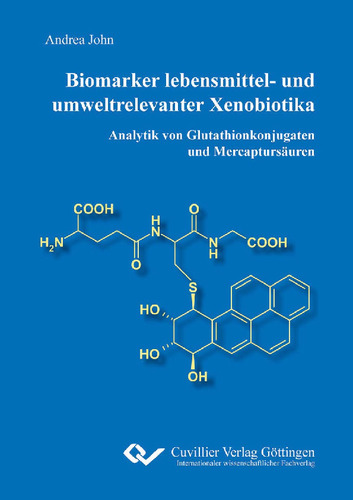
Polycyclic aromatic hydrocarbons (PAHs) represent a class of xenobiotics that occur – besides other sources – in various types of foods. Following ingestion, the PAHs are already metabolised during passage through the gastrointestinal tract by phase I and phase II enzymes. The metabolites thus formed are subsequently subject to transport by proteins of the ATP-binding cassette family localised in the epithelial cells along the digestive tract. PAHs can be converted via their respective dihydrodiols into the biologically active dihydrodiol epoxides, which have the ability to form genotoxic DNA adducts. However, there is the possibility of detoxification of the dihydrodiol epoxides through conjugation reactions with glutathione (GSH) and a subsequent excretion of the conjugates formed out of the cell.
With the aim of determining GSH conjugates of the carcinogenic PAHs benzo[a]pyrene (B[a]P), dibenzo[a,l]pyrene (DB[a,l]P) and benzo©phenanthrene (B©Phe), specific LC-ESI-MS/MS methods were developed. Medium and cell extract samples from Caco-2 cell cultures that had previously been incubated with the dihydrodiols or dihydrodiol epoxides of the respective PAH were first subjected to a purification step by means of solid-phase extraction (SPE). For the quantification of the GSH conjugates, the LC-MS/MS technique in Selected Reaction Monitoring (SRM) mode proved most suitable owing to its good sensitivity and selectivity. During this process, a fragmentation reaction of the respective molecular ion to its corresponding daughter ion took place. Additional mass spectrometric scan modes, such as the daughter scan (DAU) mode, were applied in the context of structural elucidation.
Detoxification via GSH conjugation could be successfully investigated in the Caco-2 cell model for the substance class of PAHs on the basis of its representatives B[a]P, DB[a,l]P and B©Phe using the analytical methods developed. The focus was on the detoxification of the ultimate carcinogenic dihydrodiol epoxides (+)-anti-BPDE, (-)-anti-DBPDE and (-)-anti-BcPheDE. This process comprised both the formation of the GSH conjugates and their transport out of the Caco-2 cell into the surrounding medium, which in the Transwell™ system occurred predominantly in the basolateral direction and was therefore equivalent to an excretion towards the bloodstream. The analytical procedure developed consequently allowed transport experiments to be carried out in cell culture without the need to use isotopically labelled substances.
By pretreating the cell system with specific inhibitors, the Multidrug Resistance-associated Proteins, and not the Breast Cancer Resistance Protein, could be identified as the transporters responsible for GSH conjugates. Influences of selected substances with chemopreventive potential, such as oltipraz, quercetin and butyrate, moreover brought about detoxification-promoting effects through induction of the GSH conjugate transport rate. Furthermore, incubations of Caco-2 cells with the parent hydrocarbons B[a]P, DB[a,l]P and B©Phe provided information on the metabolic competence of the cells and on the respective overall metabolite profile.
Typical low-molecular-weight aromatic hydrocarbons with only one ring system are benzene and toluene, which are also counted among the volatile organic compounds (VOC). The said VOCs can be taken up via foods, whereby the products may be contaminated by external contamination. In the case of benzene, a possible formation from the preservative benzoic acid is also discussed. In addition, inhalative exposures from exhaust gases as well as, especially in smokers, cigarette smoke must be cited as the main source of uptake for benzene. After inhalation, dermal or oral exposure, benzene and toluene are metabolised in the human body to their corresponding mercapturic acids, which are excreted with the urine along with other metabolites. This detoxification process can be used for analytical investigations in terms of determining exposure markers and at the same time represents a non-invasive technique. The clean-up of the urine samples by SPE was preceded by a sulphuric acid treatment of the urines in order to achieve a quantitative conversion of pre-mercapturic acids into mercapturic acids. With this developed method, the total content of S-phenylmercapturic acid (S-PMA) could consequently be determined. The LC-MS/MS technique served for the determination of the mercapturic acids functioning as biomarkers, whereby, owing to the high sensitivity, the SRM mode was likewise employed. The higher S-PMA contents found in smokers’ urines compared with non-smokers illustrate a greater degree of exposure of smokers to benzene. In contrast, comparable concentrations of S-benzylmercapturic acid could be detected in smokers’ and non-smokers’ urines, which possibly points to a similar exposure to toluene. S-Naphthylmercapturic acid as a biomarker of the PAH naphthalene could not be detected in the course of the investigations.
The method developed was moreover used for a qualitative analysis of further mercapturic acids of food-relevant xenobiotics. The DAU and Constant Neutral Loss (CNL) modes employed in addition to the mass spectrometric SRM mode detected the characteristic mass-to-charge ratios of the mercapturic acids of glycidamide, glycidol and acrolein. Owing to group-specific fragments, a possible applicability of the method also for unknown mercapturic acids became apparent.
In summary, it can be stated that the analytical methods developed in the present work permit a selective and sensitive determination of both GSH conjugates and mercapturic acids under in vitro and in vivo conditions by means of LC-MS/MS, which deserve great attention as biomarkers of a detoxification of intermediate reactive metabolites of carcinogenic xenobiotics.
| ISBN-13 (Printausgabe) | 3869554428 |
| ISBN-13 (Hard Copy) | 9783869554426 |
| ISBN-13 (eBook) | 9783736934429 |
| Final Book Format | A5 |
| Language | German |
| Page Number | 176 |
| Lamination of Cover | matt |
| Edition | 1 Aufl. |
| Volume | 0 |
| Publication Place | Göttingen |
| Place of Dissertation | Universität Potsdam |
| Publication Date | 2010-08-19 |
| General Categorization | Dissertation |
| Departments |
Domestic and nutritional science
|
| Keywords | polycyclic aromatic hydrocarbons, volatile organic compounds, glutathione conjugates, mercapturic acids, LC-MS/MS, Caco-2 cells, ABC-transporters |


