
Cuvillier Verlag GmbH



| Departments | |
|---|---|
| Book Series (99) |
1415
|
| Nachhaltigkeit |
3
|
| Gesundheitswesen |
3
|
| Humanities |
2414
|
| Natural Sciences |
5432
|
| Engineering |
1822
|
| Engineering | 292 |
| Mechanical and process engineering | 873 |
| Electrical engineering | 700 |
| Mining and metallurgy | 30 |
| Architecture and civil engineering | 76 |
| Common |
97
|
|
Leitlinien Unfallchirurgie
5. Auflage bestellen |
|
Advanced Search
Die Variantenselektion während der α-γ-α Phasenumwandlung in Stahl (English shop)
Ingo Lischewski (Author)Preview
Table of Contents, Datei (36 KB)
Extract, Datei (280 KB)
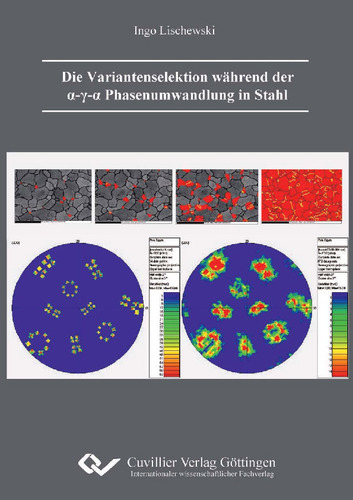
Every process step in the production of steel sheets leads to a change in material properties owing to changes in phase composition, texture and microstructure. Since in many cases cold rolling of the steels no longer takes place, hot rolling thus becomes the most important process step for adjusting the desired material properties of the flat product. During the hot rolling of microalloyed steels with low carbon content, the ferrite-austenite-ferrite (a-?-a) phase transformation takes place at high temperatures in addition to deformation and recrystallisation. This phase transformation is reversible and leads to a change in texture, crystal structure and microstructure. The crystallographic mechanism of the phase transformation can be described by a specific orientation relationship. The product texture is then also determined on this basis. During the phase transformation, however, variant selection occurs, which means that a prediction of the product texture is not readily possible. Since the texture decisively co-determines the material properties, a precise knowledge of variant selection, and of the parameters influencing it, is of great importance.
The aim of this work was to identify the decisive influencing variables that lead to variant selection and texture change during the ferrite-austenite-ferrite phase transformation in a recrystallised microalloyed steel. Since variant selection is also observed in recrystallised steels, a new development and further development of the existing models is unavoidable. For this purpose, the required data on initial and product orientation were determined locally by means of EBSD measurements and evaluated. On the basis of these investigation results, physical approaches for explaining variant selection were applied to the available measurement data and verified.
It was shown that variant selection already takes place during the nucleation stage. The product texture of the phase transformation is thus essentially determined during nucleation. Furthermore, it could be established that variant selection is a function of the crystallographic texture and the microstructure. The best possible coherence of the phase boundary through the formation of a Kurdjumov-Sachs (K-S) orientation relationship, mostly with two adjacent matrix grains, leads to a reduction of the interfacial energy and thus to the preferred formation of this nucleation geometry. Variant selection is then caused by the fact that each product orientation has a certain probability of finding a second parent grain with a K-S relationship.
The local variant selection at triple points could be determined even more precisely by incorporating the misorientation information of the grain boundary plane. A small misorientation between the crystallographic growth plane in the ferrite and the grain boundary plane leads, through improved coherence, to a further reduction of the interfacial energy. In this context, a new nucleation model for nucleation near a triple point at a grain boundary was developed. It was assumed that a higher nucleation rate is present at the triple point than at grain boundaries. Nucleation therefore begins preferentially at triple points of the microstructure. The actual nucleation, however, then takes place at the grain boundary. In this case, the grain boundary that enables the strongest reduction of the interfacial energy of the nucleus is preferred.
The present model was used to predict the variant selection of individual ferrite orientations and the complete texture development during an a-?-a transformation cycle of a microalloyed steel. Assuming a random distribution of the grain boundary planes, a successful prediction of the variant selection and of the respective product texture was achieved.
| ISBN-13 (Printausgabe) | 3869554185 |
| ISBN-13 (Hard Copy) | 9783869554181 |
| ISBN-13 (eBook) | 9783736934184 |
| Final Book Format | A5 |
| Language | German |
| Page Number | 152 |
| Lamination of Cover | glossy |
| Edition | 1 Aufl. |
| Volume | 0 |
| Publication Place | Göttingen |
| Place of Dissertation | RWTH Aachen |
| Publication Date | 2010-08-19 |
| General Categorization | Dissertation |
| Departments |
Mining and metallurgy
|


