
Cuvillier Verlag GmbH



| Departments | |
|---|---|
| Book Series (99) |
1415
|
| Nachhaltigkeit |
3
|
| Gesundheitswesen |
3
|
| Humanities |
2411
|
| Natural Sciences |
5429
|
| Engineering |
1821
|
| Engineering | 292 |
| Mechanical and process engineering | 872 |
| Electrical engineering | 700 |
| Mining and metallurgy | 30 |
| Architecture and civil engineering | 76 |
| Common |
97
|
|
Leitlinien Unfallchirurgie
5. Auflage bestellen |
|
Advanced Search
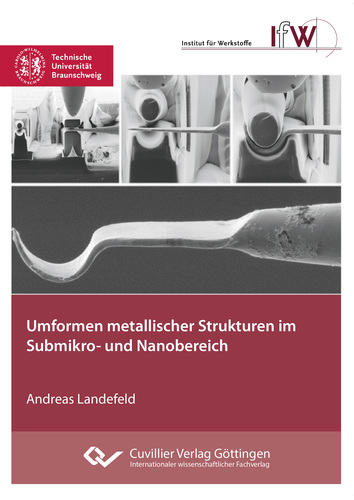
Umformen metallischer Strukturen im Submikro- und Nanobereich (English shop)
Andreas Landefeld (Author)Preview
Table of Contents, PDF (67 KB)
Extract, PDF (340 KB)
How can the manufacturing process of forming be transferred from the macroscopic to the submicro- and nanoscale, and which physical particularities must be taken into account? Clarifying these and further questions concerning the forming of metallic structures in the submicro- and nanoscale is the aim of the present dissertation. The transfer of the forming principle to the small-scale range can be realised in many aspects analogously to the macroscopic case. The tools of the ancient blacksmith – hammer, tongs and anvil – are represented in the submicro- and nanoscale by forming tools (hammers) controlled by micromanipulators and narrow, pointed tools (tongs), as well as by the silicon substrate as an analogue to the anvil.
The implementation of the forming processes in the submicro- and nanoscale is demonstrated using the examples of open-die forming, closed-die forming, bending and shear forming as well as shearing (separating processes). In this context, various solutions for the implementation with different semi-finished product geometries and semi-finished product materials are presented and discussed. Finally, possibilities for tool optimisation and alternative forming techniques are considered, and combined processes for the manufacture of first components are presented.
| ISBN-13 (Hard Copy) | 9783954049943 |
| ISBN-13 (eBook) | 9783736949942 |
| Final Book Format | A5 |
| Language | German |
| Page Number | 220 |
| Edition | 1. Aufl. |
| Publication Place | Göttingen |
| Place of Dissertation | Braunschweig |
| Publication Date | 2015-05-22 |
| General Categorization | Dissertation |
| Departments |
Engineering
|
| Keywords | Metal forming, nanotechnology, micromanipulation |


