
Cuvillier Verlag GmbH



| Departments | |
|---|---|
| Book Series (99) |
1415
|
| Nachhaltigkeit |
3
|
| Gesundheitswesen |
3
|
| Humanities |
2413
|
| Natural Sciences |
5430
|
| Engineering |
1822
|
| Engineering | 292 |
| Mechanical and process engineering | 873 |
| Electrical engineering | 700 |
| Mining and metallurgy | 30 |
| Architecture and civil engineering | 76 |
| Common |
97
|
|
Leitlinien Unfallchirurgie
5. Auflage bestellen |
|
Advanced Search
Nichtlineare Ersatzmodellierung in transsonischer instationärer Aeroelastik (English shop)
Klemens Lindhorst (Author)Preview
Table of Contents, PDF (57 KB)
Extract, PDF (360 KB)
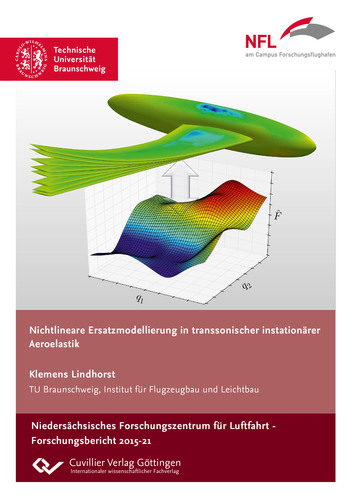
Accounting for the aeroelastic properties of an aircraft configuration is an important issue in the design of modern transport aircraft. In this context, the computation of the flow poses a particular challenge. Potential-theory-based linear methods are already widely used to solve the flow problem within aeroelastic analyses. These methods provide reliable results in the subsonic flight regime.
In the transonic regime, however, in which the cruise speeds of most modern aircraft lie, nonlinear aerodynamic effects occur to an increased extent. These effects are not captured by the linear methods, which is why these methods can only be applied to a limited extent. Although higher-fidelity numerical solution methods are able to capture nonlinear effects, they require a considerable amount of computing time and resources, which is why these methods are not applied on a large scale.
For this reason, an approach is developed in this work that enables the construction of a surrogate model on the basis of a limited number of costly numerical flow analyses. This surrogate model is designed to predict the flow quantities relevant to aeroelastic analyses with a quality comparable to that of the numerical method, while requiring only a fraction of the computing time and resources. In addition, the surrogate model is intended to be applicable to high-dimensional nonlinear fields, so that its use for more complex three-dimensional problems is also made possible.
The practical suitability of the developed approach is demonstrated in this work on three different aeroelastic models. First, the two-dimensional NLR7301 airfoil with two degrees of freedom of motion, which exhibits significant nonlinear aerodynamic properties, is investigated. Subsequently, the AGARD445.6 wing is considered as a simple three-dimensional case, for which a flutter analysis in the transonic regime is carried out using the surrogate model. Finally, the surrogate modelling approach is applied to the realistic three-dimensional HIRENASD configuration, which is regarded as a case of industrial scale. The robustness and stability of the approach are demonstrated on the basis of variations of the structural model as well as of the angle of attack. As an outlook for further developments, gust prediction by means of the surrogate model is investigated.
In the test cases, the developed approach proves to be an effective, complementary tool for high-fidelity numerical aeroelastic investigations.
| ISBN-13 (Hard Copy) | 9783736991767 |
| ISBN-13 (eBook) | 9783736981768 |
| Final Book Format | A5 |
| Language | German |
| Page Number | 200 |
| Edition | 1. Aufl. |
| Publication Place | Göttingen |
| Place of Dissertation | Braunschweig |
| Publication Date | 2015-01-07 |
| General Categorization | Dissertation |
| Departments |
Mechanical and process engineering
Aerospace engineering |
| Keywords | Aeroelasticity, Nonlinear Surrogate Modelling, Reduced Order Modelling, Computational Fluid Dynamics (CFD), Proper Orthogonal Decomposition (POD), Neural Networks |


