
Cuvillier Verlag GmbH



| Departments | |
|---|---|
| Book Series (99) |
1415
|
| Nachhaltigkeit |
3
|
| Gesundheitswesen |
3
|
| Humanities |
2410
|
| Natural Sciences |
5428
|
| Engineering |
1820
|
| Engineering | 292 |
| Mechanical and process engineering | 872 |
| Electrical engineering | 699 |
| Mining and metallurgy | 30 |
| Architecture and civil engineering | 76 |
| Common |
97
|
|
Leitlinien Unfallchirurgie
5. Auflage bestellen |
|
Advanced Search
ArchitekturForm & SolarEnergie (English shop)
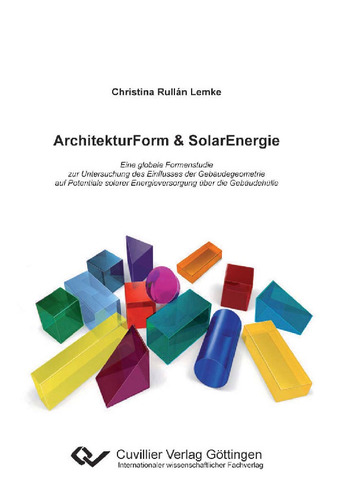
Eine globale Formenstudie zur Untersuchung des Einflusses der Gebäudegeometrie auf Potentiale solarer Energieversorgung über die Gebäudehülle
Christina Rullán Lemke (Author)Preview
Table of Contents, Datei (70 KB)
Extract, Datei (62 KB)
Form follows Energy, or The Price of the Right Angle
Around the globe, the built environment of modern humans consists largely of variations on the cube: blocks, towers, slabs, halls or rows. The orthogonal planning grid dominates the architectural language of form just as much as the conviction that buildings are inevitably energy consumers. Building-envelope-integrated solar technologies, however, make it possible for the first time in history to actively generate energy on building surfaces and, consequently, to regard the house as a potential power plant. But are conventional building forms in fact suited to harvesting solar energy? What energy potential could an adapted building geometry offer compared with conventional building forms? Would it be worthwhile to develop a new architectural language of form? What significance would lie in liberation from old design patterns?
In this research, conventional and unconventional building forms compete against one another in an energy contest at locations worldwide, from the pole to the equator – with an unambiguous result. For adhering to the conventional canon of forms, and especially for exporting it to developing and emerging countries, we are paying a high price: the right angle is costing us the chance of a solar future.
| ISBN-13 (Printausgabe) | 3869553715 |
| ISBN-13 (Hard Copy) | 9783869553719 |
| ISBN-13 (eBook) | 9783736933712 |
| Final Book Format | A5 |
| Language | German |
| Page Number | 392 |
| Edition | 1 Aufl. |
| Volume | 0 |
| Publication Place | Göttingen |
| Place of Dissertation | TU Hamburg-Harburg |
| Publication Date | 2010-06-28 |
| General Categorization | Dissertation |
| Departments |
Engineering
|


