
Cuvillier Verlag GmbH



| Departments | |
|---|---|
| Book Series (99) |
1415
|
| Nachhaltigkeit |
3
|
| Gesundheitswesen |
3
|
| Humanities |
2411
|
| Natural Sciences |
5430
|
| Mathematics | 230 |
| Informatics | 320 |
| Physics | 982 |
| Chemistry | 1371 |
| Geosciences | 131 |
| Human medicine | 246 |
| Stomatology | 10 |
| Veterinary medicine | 112 |
| Pharmacy | 147 |
| Biology | 837 |
| Biochemistry, molecular biology, gene technology | 121 |
| Biophysics | 25 |
| Domestic and nutritional science | 45 |
| Agricultural science | 1006 |
| Forest science | 201 |
| Horticultural science | 20 |
| Environmental research, ecology and landscape conservation | 149 |
| Engineering |
1821
|
| Common |
97
|
|
Leitlinien Unfallchirurgie
5. Auflage bestellen |
|
Advanced Search
Lipidextrusion - Prozessoptimierung für nadelförmige Arzneistoffe und Freisetzungsverhalten (English shop)
Rieke Draheim (Author)Preview
Table of Contents, Datei (24 KB)
Extract, Datei (67 KB)
The aim of this work was to develop taste-masked formulations for animals containing the bitter-tasting and needle-shaped drug praziquantel by means of lipid extrusion. The smallest possible die diameters below 0.5 mm were to be used, which is advantageous for taste masking of the bitter drug.
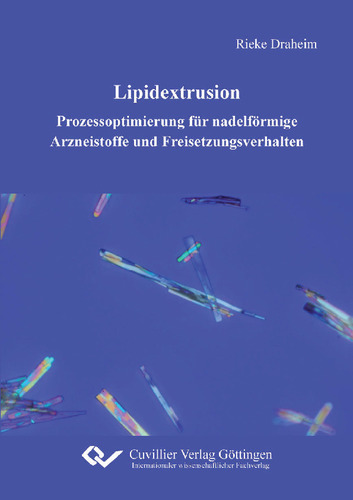
This work demonstrated for the first time that needle-shaped substances cause problems during lipid extrusion and in some cases cannot be processed at all. These problems become more pronounced the smaller the die diameters used. Experiments with praziquantel and two further needle-shaped model drugs showed that milling yields particle shapes with which the lipid extrusion process can be carried out without difficulty. Comparable difficulties in processing needle-shaped drugs had previously only been known from tableting.
During extrusion of praziquantel with triglycerides as matrix formers, electrostatic charging of the extrudates occurred due to friction at the inner die surfaces. The extrudates adhered to the outside of the die head and the dies became blocked. With liquid polyethylene glycol (PEG), an antistatic agent for lipid extrusion was found. Addition of PEG at concentrations from 10% prevents electrostatic charges and markedly improves the process. The molecular weight of the PEG is chosen such that it is liquid during extrusion and solid after cooling.
Using milled praziquantel and PEG as an antistatic agent, it is possible to carry out the lipid extrusion process with a wide range of lipids, from glycerides through waxes to paraffins. Extrudates with particularly small diameters down to a minimum of 0.2 mm can be produced, which can be loaded with up to 70% praziquantel. Extrudates with a diameter of 0.3 mm can even be produced with 80% praziquantel.
In a scale-up trial, the lipid extrusion of praziquantel and the subsequent milling of the extrudates in a centrifugal mill were carried out continuously. This was achieved by picking up the extrudate at the dies with a conveyor belt and feeding it directly into the mill. Conversely, in a scale-down trial it was possible to extrude 100 g of material by shortening the extruder barrel and using only part of the screws.
In lipid formulations, PEG acts not only as an antistatic agent but also as a pore former, thereby accelerating the release of a drug from the lipid matrix. By varying the PEG content in the lipid matrix and the extrudate diameter, it was possible to develop both slow-releasing and accelerated-releasing formulations with praziquantel that remain physically stable after open storage under stress conditions. In a palatability study in cats, the bitter drug praziquantel proved to be taste-masked by formulation as a lipid extrudate. Preparations with accelerated release due to PEG addition were also accepted by 100% of the cats.
In addition to dissolution tests in hydrochloric acid, investigations were carried out in biorelevant media. Surface-active substances such as bile salts and phospholipids have a considerable effect on release from lipid extrudates. Pancreatic lipase, by contrast, hardly degrades solid lipids and contributes less to drug release.
In this work, taste-masked formulations with praziquantel were developed and the lipid extrusion process with small dies was optimised. Beyond this, a general contribution could be made both to the understanding of the processing of needle-shaped drugs and to extrusion with particularly small dies, to electrostatic charges during lipid extrusion, and to the release from solid lipid matrices in biorelevant media.
| ISBN-13 (Printausgabe) | 3869553707 |
| ISBN-13 (Hard Copy) | 9783869553702 |
| ISBN-13 (eBook) | 9783736933705 |
| Language | German |
| Page Number | 124 |
| Edition | 1 Aufl. |
| Volume | 0 |
| Publication Place | Göttingen |
| Place of Dissertation | Universität Düsseldorf |
| Publication Date | 2010-06-17 |
| General Categorization | Dissertation |
| Departments |
Pharmacy
|


