
Cuvillier Verlag GmbH



| Departments | |
|---|---|
| Book Series (99) |
1415
|
| Nachhaltigkeit |
3
|
| Gesundheitswesen |
3
|
| Humanities |
2413
|
| Natural Sciences |
5430
|
| Mathematics | 230 |
| Informatics | 320 |
| Physics | 982 |
| Chemistry | 1371 |
| Geosciences | 131 |
| Human medicine | 246 |
| Stomatology | 10 |
| Veterinary medicine | 112 |
| Pharmacy | 147 |
| Biology | 837 |
| Biochemistry, molecular biology, gene technology | 121 |
| Biophysics | 25 |
| Domestic and nutritional science | 45 |
| Agricultural science | 1006 |
| Forest science | 201 |
| Horticultural science | 20 |
| Environmental research, ecology and landscape conservation | 149 |
| Engineering |
1822
|
| Common |
97
|
|
Leitlinien Unfallchirurgie
5. Auflage bestellen |
|
Advanced Search
Aromatische Prenyltransferasen aus Hypericum-Arten (English shop)
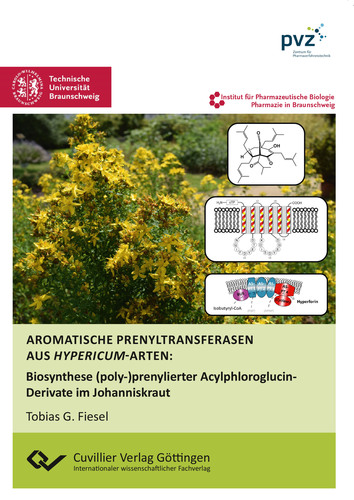
Biosynthese (poly-)prenylierter Acylphloroglucin-Derivate im Johanniskraut
Tobias Fiesel (Author)Preview
Table of Contents, PDF (120 KB)
Extract, PDF (840 KB)
Polycyclic polyprenylated acylphloroglucinols (PPAPs) are a group of plant secondary metabolites characterised by complex molecular structures and a wide range of interesting bioactivities. From the current scientific perspective, hyperforin – probably the best-studied PPAP and the main constituent of the medicinal plant St. John’s wort (Hypericum perforatum L.) – is credited with a central role in the antidepressant efficacy of St. John’s wort extracts as well as with further promising pharmacological properties. Given the rising number and projected increase of mental illnesses, the demand for St. John’s wort, and for hyperforin in particular, cannot be met through cultivation or elaborate and thus far uneconomical total syntheses; a possible biotechnological production therefore attracts great interest. A prerequisite for this is the discovery and utilisation of the enzymes involved in the hyperforin biosynthetic pathway, which is largely based on predictions. The present dissertation deals with the search for, identification, molecular biological investigation and functional analysis of aromatic secondary metabolism prenyltransferases from H. perforatum involved in this pathway. Knowledge of their genetic information and of the enzymatic functions of the corresponding gene products forms the basis for the future implementation of a possible “green synthesis” of hyperforin and related bioactive natural products in homologous or adequate production systems.
| ISBN-13 (Hard Copy) | 9783736994614 |
| ISBN-13 (eBook) | 9783736984615 |
| Final Book Format | A5 |
| Language | German |
| Page Number | 198 |
| Lamination of Cover | glossy |
| Edition | 1. Aufl. |
| Publication Place | Göttingen |
| Place of Dissertation | Braunschweig |
| Publication Date | 2017-01-24 |
| General Categorization | Dissertation |
| Departments |
Organic chemistry
Pharmacy Pharmaceutical biology / Pharmacognosy Microbiology and biotechnology |
| Keywords | Hypericum, St. John's wort, secondary metabolites, hyperforin, prenyltransferases, depression |


