
Cuvillier Verlag GmbH



| Departments | |
|---|---|
| Book Series (99) |
1415
|
| Nachhaltigkeit |
3
|
| Gesundheitswesen |
3
|
| Humanities |
2413
|
| Natural Sciences |
5430
|
| Mathematics | 230 |
| Informatics | 320 |
| Physics | 982 |
| Chemistry | 1371 |
| Geosciences | 131 |
| Human medicine | 246 |
| Stomatology | 10 |
| Veterinary medicine | 112 |
| Pharmacy | 147 |
| Biology | 837 |
| Biochemistry, molecular biology, gene technology | 121 |
| Biophysics | 25 |
| Domestic and nutritional science | 45 |
| Agricultural science | 1006 |
| Forest science | 201 |
| Horticultural science | 20 |
| Environmental research, ecology and landscape conservation | 149 |
| Engineering |
1822
|
| Common |
97
|
|
Leitlinien Unfallchirurgie
5. Auflage bestellen |
|
Advanced Search
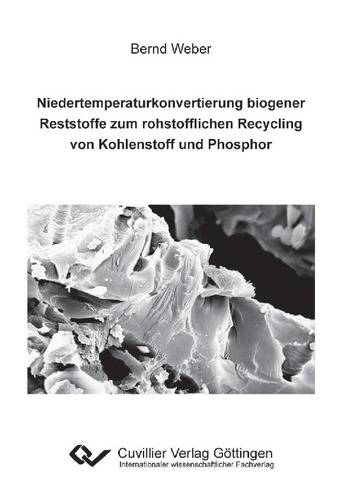
Niedertemperaturkonvertierung biogener Reststoffe zum rohstofflichen Recycling von Kohlenstoff und Phosphor (English shop)
Bernd Weber (Author)Preview
Table of Contents, Datei (50 KB)
Extract, Datei (140 KB)
This study examines the utilisation of organic residues by means of low-temperature conversion. It presents approaches to the recycling of the elements carbon and phosphorus. The experimental investigations are based on products from static conversions of the substrates (rapeseed press cake, sewage sludge, animal and meat and bone meal, grain stillage and apple pomace) in a tubular laboratory furnace at 400 °C under a nitrogen atmosphere, and on two continuously operated pilot plants. One focus lies on improving the product properties by adding soda to the substrate prior to conversion. The resulting conversion oils are characterised by a higher degree of defunctionalisation of heteroatoms. With regard to the oxygen concentration in the conversion oil of the substrates investigated, this amounts to about 10 % without the addition of soda and is reduced to about 5 % by conversion in the presence of soda. The qualitative improvement can be attributed to an alkaline saponification of the lipids with subsequent thermal decomposition of the sodium salts of the fatty acids. Water is consumed in the course of these reaction sequences. Building on this, an almost complete decarboxylation of the fats into hydrocarbons is achieved in a pilot-scale plant ( = 20 kg/h) using animal fat as the starting substrate.
After conversion, the organically bound phosphorus of the biogenic residues may be present as polyphosphate in the char formed. In contrast, ortho-phosphates are formed when soda is added prior to conversion. These are largely water-soluble. The plant availability of these phosphates is demonstrated in a pot experiment with perennial ryegrass (Lolium perenne L.). Stable phosphates already present in the starting substrate, such as apatite or iron phosphate, are not altered during low-temperature conversion. The direct use of the phosphate-containing char from low-temperature conversion in fertiliser concepts opens up additional possibilities for the long-term fixation of carbon in the soil. Fuel analyses of the char from low-temperature conversion show that the conversion of rapeseed press cake, grain stillage and apple pomace yields solid residues with the physical properties of hard coals. In contrast, the conversion of sewage sludge, animal and meat and bone meal predominantly yields solid products of the “lignite” type.
| ISBN-13 (Printausgabe) | 3869553324 |
| ISBN-13 (Hard Copy) | 9783869553320 |
| ISBN-13 (eBook) | 9783736933323 |
| Language | German |
| Page Number | 218 |
| Edition | 1 Aufl. |
| Volume | 0 |
| Publication Place | Göttingen |
| Place of Dissertation | Universität Gießen |
| Publication Date | 2010-05-17 |
| General Categorization | Dissertation |
| Departments |
Agricultural science
Environmental research, ecology and landscape conservation |


