
Cuvillier Verlag GmbH



| Departments | |
|---|---|
| Book Series (99) |
1415
|
| Nachhaltigkeit |
3
|
| Gesundheitswesen |
3
|
| Humanities |
2411
|
| Medienwissenschaften | 17 |
| Theology | 57 |
| Philosophy | 103 |
| Law | 430 |
| Economics | 863 |
| Social sciences | 423 |
| Sports science | 48 |
| Psychology | 233 |
| Educational science | 190 |
| History | 194 |
| Art | 111 |
| Cultural studies | 167 |
| Literary studies | 118 |
| Linguistics | 91 |
| Natural Sciences |
5429
|
| Engineering |
1821
|
| Common |
97
|
|
Leitlinien Unfallchirurgie
5. Auflage bestellen |
|
Advanced Search
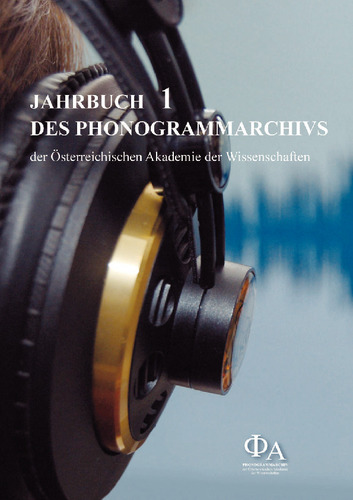
Jahrbuch des Phonogrammarchivs der Österreichischen Akademie der Wissenschaften (English shop)
1
Clemens Gütl (Author)Gerda Lechleitner (Author)
Christian Liebl (Author)
Preview
Table of Contents, Datei (24 KB)
Extract, Datei (560 KB)
This first volume of the Yearbook of the Phonogrammarchiv of the Austrian Academy of Sciences contains the papers of the international symposium on the topic “Reflections on Fields of Work, Cooperations and Perspectives”, held in 2009 on the occasion of the institution’s 110th anniversary, as well as a condensed annual report of the institution.
The conference contributions are divided into three sections, preceded by words of greeting from Kevin Bradley (International Association of Sound and Audiovisual Archives), Rainer Hubert (Medienarchive Austria) and Detlef Altenburg (Gesellschaft für Musikforschung) as well as a keynote lecture by Anthony Seeger (UCLA). Starting from an analytical look into the past, Seeger illuminates the special significance of audiovisual archives in the 21st century and emphasises the great value of sound documents as a source for understanding cultures in the context of a globalised world. On the basis of his own field research, Seeger covers a wide range of issues, from the interaction between performers, researchers and archivists to sensitive topics such as copyright and ethics in dealing with audiovisual documents.
The first section (“Methods and Aims of Field Research”) opens with a contribution by Ingeborg Geyer on the added value of “lifelike tape recordings” for dialectological research, especially for the compilation of the dictionary of Bavarian dialects in Austria. Using the “Kranzmayer-Hornung Collection” from the 1950s, held in the Phonogrammarchiv, she stresses its importance for the validation and analysis of linguistic phenomena, but also for questions in cultural studies. Gerhard Kubik reflects on the “encounter of cultures” as he recalls his first field research trips in the early 1960s and attempts to contrast today’s perspective with his considerations and aims at that time. Starting from European experiences, Kubik’s excursus ranges from the departure for Africa, where most of his journeys took him, to a new view and mode of representation of cultural profiles. Rudolf M. Brandl’s contribution “On the Source Criticism of Media Transmission Using the Paradigm of Music Recording” constitutes a methodological treatise on the value of AV sources in connection with the recording of oral traditions, in which a fundamental distinction is made between the physical carrier and the content. Brandl regards music as “communicative action” and deduces from this approach that media documentation can never be objective – a conclusion that must also be taken into account when archiving an AV document.
In the second thematic block (“Technical Challenges in the Field and in the Archive”), Giorgio Adamo first sets out his findings from AV recordings in the field, describing how differently auditory and visual information can be perceived and recorded during a video recording. Ultimately he concludes that although a pure sound recording is “more objective” than any video recording, the appropriate type of recording and methodological constellation must be decided anew depending on the context and research aim. In their article, Victor Denisov and Tjeerd de Graaf address the role of archives in the preservation, documentation and provision of access to holdings on endangered languages in Russia. The two authors report on their many years of experience with recordings of endangered languages (in particular Finno-Ugric minority languages such as Khanty and Udmurt) in Russian archives. Both Jacek Jackowski and Avraham Nahmias report on their findings from a training course at the Phonogrammarchiv, which has always dealt intensively with questions of conservation, restoration and transfer of sound carriers, has passed on this expertise worldwide and has thereby gained an international reputation. The resulting cooperations – in one case with Warsaw, in the other with Jerusalem – are discussed in detail in connection with the knowledge transfer that took place, alongside a description of the institutions concerned.
The concluding chapter (“The Role of Sound Archives for Linguistics and Musicology”) is introduced by a paper on “Language, Dislocation and Identity among the Uzbeks of North-Eastern Afghanistan”, in which Ingeborg Baldauf traces the cultural, political and linguistic developments from 1978 to 2008 and points to the significance of linguistic sound recordings as contemporary documents for insights in cultural studies. Using the examples of oral historical tradition and dress, Baldauf shows that studies of local idioms must be accompanied by an investigation of migration history as well as of parallel – language-bound and non-linguistic – identity-forming features. A further linguistic contribution comes from John Rennison, who takes as his subject the computer-assisted analysis of audiovisual data material from linguistic field research. In his text he passes on practical tips about personally tested computer programmes for the analysis of language corpora which came about with technical support from the Phonogrammarchiv and are archived there for the long term. Finally, Detlef Altenburg opens new horizons with the legitimate question of the relationship between phonogram archives and musicology. He expects the still fleeting mutual perception of the different subfields of the discipline to diminish in the future, especially as sonic reality increasingly comes to the fore and engagement with sound recordings – and consequently also the significance of sound archives for the collective memory of cultures – will increase. The precondition for this, however, is worldwide availability via the internet.
| ISBN-13 (Printausgabe) | 3869552956 |
| ISBN-13 (Hard Copy) | 9783869552958 |
| ISBN-13 (eBook) | 9783736932951 |
| Final Book Format | A5 |
| Language | German |
| Page Number | 222 |
| Lamination of Cover | matt |
| Edition | 1 Aufl. |
| Volume | 0 |
| Publication Place | Göttingen |
| Publication Date | 2010-04-14 |
| General Categorization | Non-Fiction |
| Departments |
Social sciences
Musicology Cultural studies Linguistics |
| Keywords | Periodical, Local and Regional History, Regional History, Non-European History, History of Science and Technology, Auxiliary Historical Sciences: Palaeography, Numismatics, Heraldry, Genealogy, Non-European Linguistics, Literary and Cultural Studies, German and European Folklore Studies, Ethnology, Measurement and Control Engineering, Communications and Telecommunications Engineering |


