
Cuvillier Verlag GmbH



| Departments | |
|---|---|
| Book Series (99) |
1415
|
| Nachhaltigkeit |
3
|
| Gesundheitswesen |
3
|
| Humanities |
2412
|
| Natural Sciences |
5430
|
| Mathematics | 230 |
| Informatics | 320 |
| Physics | 982 |
| Chemistry | 1371 |
| Geosciences | 131 |
| Human medicine | 246 |
| Stomatology | 10 |
| Veterinary medicine | 112 |
| Pharmacy | 147 |
| Biology | 837 |
| Biochemistry, molecular biology, gene technology | 121 |
| Biophysics | 25 |
| Domestic and nutritional science | 45 |
| Agricultural science | 1006 |
| Forest science | 201 |
| Horticultural science | 20 |
| Environmental research, ecology and landscape conservation | 149 |
| Engineering |
1821
|
| Common |
97
|
|
Leitlinien Unfallchirurgie
5. Auflage bestellen |
|
Advanced Search
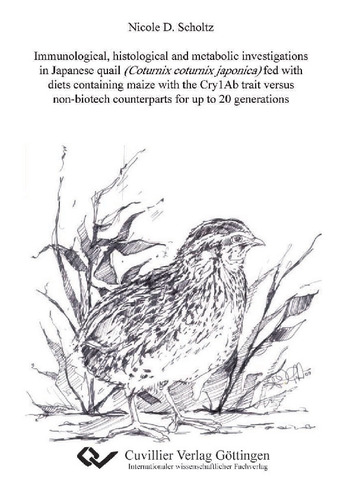
Immunological, histological, and metabolic investigations in Japanese quail (Coturnix coturnix japonica) fed with diets containing maize with the Cry1Ab trait versus non-biotech counterparts for up to 20 generations (English shop)
Nicole Scholtz (Author)Preview
Table of Contents, Datei (35 KB)
Extract, Datei (51 KB)
The aim of this dissertation was to advance the ongoing debate as to whether the intake of feedstuffs containing Cry1Ab maize has effects on health compared with isogenic maize. For this purpose, the Japanese quail was used as a model organism. First, clinical-chemical reference values were established from up to 125 male and 151 female adult birds. As expected, differences between the sexes occurred in the majority of the parameters examined.
In the subsequent multigenerational study, birds of the 17th to 20th generation were compared, which were fed either Bacillus thuringiensis maize (Bt) or isogenic maize (ISO) (n=40/feeding group and sex). The investigations were extended to birds receiving Bt maize in the first generation (n=30/feeding group and sex) and to two additional control groups fed isogenic reference maize (REF) (n=30/feeding group and sex). At the age of 16 weeks, clinical-chemical parameters were analysed and the liver tissue was examined histologically. Significant differences occurred in only some of the parameters considered. However, these differences were neither consistent nor analogous and were not confined to comparisons between Bt vs. ISO, or REF.
Finally, the effect of active immunisation with bovine serum albumin (BSA) was tested in feeding trials with Bt or isogenic maize. After 16 weeks of feeding the experimental diets, half of the birds per feeding group were injected with BSA or NaCl, respectively; from half of these (n=30) blood samples were collected after 36 h and analysed for their zinc content. From the remaining birds, egg yolk samples were collected every two weeks for a total of six weeks after the injection and the concentrations of total IgY as well as BSA-specific IgY were measured. For both parameters, no differences between the feeding groups occurred. In the group of birds fed Bt maize, a higher zinc concentration was determined compared with the isogenically fed control birds after the samples from BSA- and NaCl-injected birds of the respective feeding group had been pooled. The results of this study provide no indication that feeding Bt maize impairs the immune system of Japanese quail.
The analysis of the nutrient contents as well as the concentrations of the mycotoxins deoxynivalenol and zearalenone in the feed mixtures used showed no differences between the feeding groups. Moreover, the mycotoxin concentrations were consistently below the maximum levels accepted by the EU Commission.
The absence of negative health effects in the investigations conducted contributes to the ongoing discussion regarding the use of genetically modified cereals in animal nutrition. The results are of general importance for animal science and support the comparability of Bt maize with conventional maize varieties with respect to animal health.
| ISBN-13 (Printausgabe) | 3869553081 |
| ISBN-13 (Hard Copy) | 9783869553085 |
| ISBN-13 (eBook) | 9783736933088 |
| Language | German |
| Page Number | 92 |
| Edition | 1 Aufl. |
| Volume | 0 |
| Publication Place | Göttingen |
| Place of Dissertation | Universität Bonn |
| Publication Date | 2010-04-13 |
| General Categorization | Dissertation |
| Departments |
Agricultural science
|


