
Cuvillier Verlag GmbH



| Departments | |
|---|---|
| Book Series (99) |
1415
|
| Nachhaltigkeit |
3
|
| Gesundheitswesen |
3
|
| Humanities |
2412
|
| Natural Sciences |
5430
|
| Mathematics | 230 |
| Informatics | 320 |
| Physics | 982 |
| Chemistry | 1371 |
| Geosciences | 131 |
| Human medicine | 246 |
| Stomatology | 10 |
| Veterinary medicine | 112 |
| Pharmacy | 147 |
| Biology | 837 |
| Biochemistry, molecular biology, gene technology | 121 |
| Biophysics | 25 |
| Domestic and nutritional science | 45 |
| Agricultural science | 1006 |
| Forest science | 201 |
| Horticultural science | 20 |
| Environmental research, ecology and landscape conservation | 149 |
| Engineering |
1821
|
| Common |
97
|
|
Leitlinien Unfallchirurgie
5. Auflage bestellen |
|
Advanced Search
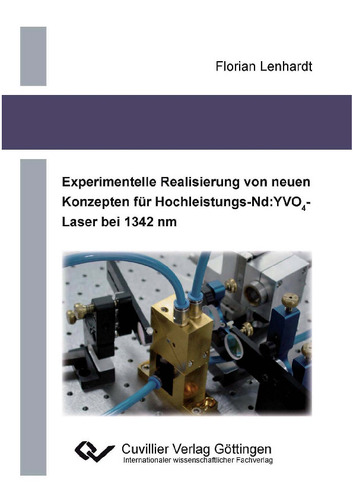
Experimentelle Realisierung von neuen Konzepten für Hochleistungs-Nd:YVO4-Laser bei 1342 nm (English shop)
Florian Lenhardt (Author)Preview
Table of Contents, Datei (40 KB)
Extract, Datei (180 KB)
This work covers the development and characterization of high-power continuous-wave, nanosecond and picosecond 1342 nm lasers based on the solid-state material Nd:YVO4. Such compact and efficient diode-pumped solid-state lasers at 1342 nm have a wide variety of applications, for example in fiber optics or in medicine. Above all, the second and third harmonics of the 1342 nm radiation, which lie at 671 nm and 447 nm and thus in the red and blue spectral range, open up further large fields of application, especially for wavelength-sensitive processes in the visible. For the generation of the 1342 nm laser radiation, the 4F3/2 → 4I13/2 transition in Nd:YVO4 is exploited. This exhibits a lower cross section for stimulated emission than the strongest transition at a wavelength of 1064 nm. Until now, the output power of 1342 nm lasers has been limited by the very high heat load introduced into the laser crystal during 1342 nm emission. Due to the high quantum defect and the additionally occurring excited state absorption, 40 % of the absorbed pump power contributes directly to the heating of the crystal. This leads to very strong thermally induced lenses and, in extreme cases, to the destruction of the laser crystal. Through optical excitation at 888 nm and the use of a low-doped 30 mm long Nd:YVO4 crystal, the heat load can be distributed over a large volume. This makes possible the use of high pump powers of up to 110 W without destruction of the crystal, and the thermally induced lens is considerably reduced. By means of a numerical simulation of the thermo-optical and thermo-mechanical properties of the laser crystal and the experimental determination of the focal length of the thermal lenses, it is possible to develop a resonator that permits stable mode-matched laser operation. With the aid of this pumping concept, a laser can be realized that emits diffraction-limited radiation in continuous-wave operation at a maximum output power of 24 W. To date there are no high-power continuous-wave sources in the red spectral range based on the frequency doubling of the radiation of a solid-state laser at 1.3 µm. This is attributable to the lack of suitable lasers at 1.3 µm. Building on this continuous-wave source at 1342 nm, radiation at 671 nm can be efficiently generated by means of external frequency doubling in magnesium oxide-doped periodically poled lithium niobate (MgO:PPLN). The efficiency here amounts to 51 %, corresponding to a power of 10 W. By means of active Q-switching with an acousto-optic modulator (AOM), it is possible to modify the given continuous-wave Nd:YVO4 laser for the emission of nanosecond pulses with very high pulse peak powers of up to 108 kW. By shortening the resonator, a minimum pulse duration of 14.8 ns can be achieved. The average output power lies, depending on the repetition rate, between 10 W and 20 W. The laser is optimized for the repetition rate range between 6 kHz and 30 kHz, which is why it exhibits stable operation in the fundamental Gaussian mode for these repetition rates. The high peak powers and very good beam quality of the presented ns Nd:YVO4 laser ensure an efficient generation of the second and third harmonics in bismuth borate (BiBO) and lithium triborate (LBO), respectively. Average output powers of 12.2 W at 671 nm and 6.8 W at 447 nm are generated. This corresponds to high conversion efficiencies of 62 % and 49 %. The output powers for ps lasers at 1342 nm have so far been limited, on the one hand, by the thermal problems at 1342 nm, but above all by the lack of suitable mode-locking techniques at 1342 nm. The technique of parametric Kerr lens mode locking (PKLM) is based on a lensing effect equivalent to the Kerr effect, which is generated by a cascaded χ(2) process in a nonlinear crystal. With PKLM, stable cw mode locking at 1064 nm has been achieved in the past. Therefore, the transfer of this technique to an emission wavelength of 1342 nm presented in this work demonstrates a possibility for power scaling. The presented picosecond Nd:YVO4 laser at 1342 nm exhibits self-starting cw mode locking by means of PKLM. No indication of a cw background of the mode-locked radiation is discernible. To convert the phase modulation into an amplitude (loss) modulation, a mode aperture is used. Thereby an average output power of the mode-locked radiation of up to 6.5 W at a pulse duration of 20 ps is achieved. A maximum pulse peak power of 7.3 kW is emitted at an average output power of 4.8 W and a pulse duration of 4 ps. The mode locking is stable over several hours without signs of dropouts. The system thus represents the first laser at 1342 nm mode-locked by pure PKLM. By external frequency doubling of the ps Nd:YVO4 laser in a short MgO:PPLN crystal, an average output power of 2.28 W in the red spectral range is generated at a conversion efficiency of 49 %; on the other hand, this also confirms the absence of a cw background in the mode-locked radiation. The present work demonstrates that, with the aid of optical excitation at 888 nm and the analysis of the thermal properties of the laser material, power scaling of lasers at 1342 nm is possible. Based on a high-power continuous-wave laser, ns pulses can be generated by means of an AOM and ps pulses with the PKLM technique. In addition, through frequency doubling and frequency tripling of the 1342 nm lasers, high-power radiation in the visible spectral range can be generated.
| ISBN-13 (Printausgabe) | 395404045X |
| ISBN-13 (Hard Copy) | 9783954040452 |
| ISBN-13 (eBook) | 9783736940451 |
| Final Book Format | A5 |
| Language | German |
| Page Number | 196 |
| Lamination of Cover | glossy |
| Edition | 1 Aufl. |
| Volume | 0 |
| Publication Place | Göttingen |
| Place of Dissertation | Kaiserslautern |
| Publication Date | 2012-03-09 |
| General Categorization | Dissertation |
| Departments |
Physics
|


