
Cuvillier Verlag GmbH



| Departments | |
|---|---|
| Book Series (99) |
1415
|
| Nachhaltigkeit |
3
|
| Gesundheitswesen |
3
|
| Humanities |
2410
|
| Natural Sciences |
5428
|
| Mathematics | 229 |
| Informatics | 320 |
| Physics | 982 |
| Chemistry | 1371 |
| Geosciences | 131 |
| Human medicine | 246 |
| Stomatology | 10 |
| Veterinary medicine | 112 |
| Pharmacy | 147 |
| Biology | 837 |
| Biochemistry, molecular biology, gene technology | 121 |
| Biophysics | 25 |
| Domestic and nutritional science | 45 |
| Agricultural science | 1005 |
| Forest science | 201 |
| Horticultural science | 20 |
| Environmental research, ecology and landscape conservation | 148 |
| Engineering |
1820
|
| Common |
97
|
|
Leitlinien Unfallchirurgie
5. Auflage bestellen |
|
Advanced Search
Laserdiagnostische Untersuchung der Tröpfchenverbrennung an einer turbulenten Freistrahlflamme mittels Raman-Spektroskopie (English shop)
Dietmar Malcherek (Author)Preview
Table of Contents, Datei (34 KB)
Extract, Datei (250 KB)
The investigation of combustion processes is very imprecise when carried out with conventional means at moderate spatial and temporal resolution. Often the difficult accessibility of the location at which combustion takes place precludes any investigative methodology that would lead to deeper insights into the combustion process. With laser spectroscopy, however, at very high temporal and spatial resolution, precisely that information can be obtained which the reactants generate in a thermal-chemical interplay. With the decisive advantage of being non-intrusive, the laser light interacts with the reactants participating in the chemical reaction; this interaction not only provides important insights via emission spectra in a molecule-specific manner, like a genetic fingerprint, but also leaves the medium under investigation unchanged in its original state. By means of suitable evaluation mechanisms, parameters such as mole fraction, temperature distribution, mixture fraction, etc. can thus be determined simultaneously and in situ, even under very hot and aggressive conditions.
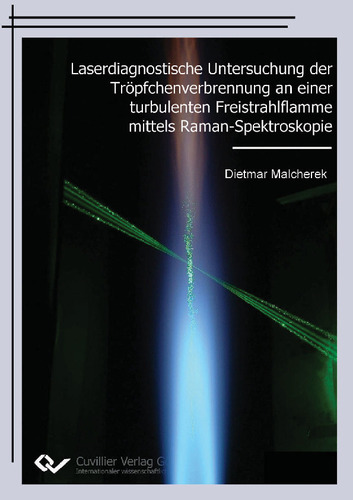
In the present work, a turbulent piloted free-jet flame was investigated by laser diagnostics using Raman spectroscopy. With an evaluation procedure suitable for and adapted to this experiment, the mole fractions of the species (CO2, O2, CO, N2, CH4, H2O and H2) as well as their standard deviation, temperature distribution and mixture fraction could be determined and compared with the results of a hybrid PDF simulation. In a second step, fuel droplets (ethanol) were introduced into the flame in the same flame configuration and the modified combustion behaviour was detected by Raman spectroscopy in a grid-like manner over the entire flame. In regions in which the influence of the liquid fuel has the most pronounced effect, the clearest changes compared with the pure gas flame were found in the species CO2, O2 and H2O: in the region of chemical equilibrium, an increase in the mole fraction of CO2 could be detected at a height of 250 mm above the burner head and a radial displacement of 10 mm from the centre axis. With a value of 0.09, the mole fraction of CO2 lies 10% above that of the turbulent flame in single-phase operation (0.08); the mole fractions of the species H2O and O2 are reduced to 0.18 for H2O, by 5% (from 0.19), and for O2 to 0.020, by 17% (from 0.028) (cf. Chap. 2.1). The temperature for the single-phase turbulent flame is 2110 K and increases by 3% to 2170 K as a result of the fuel supply. With regard to CO and H2, no concrete statements are possible, and these are considered only to a limited extent owing to the more difficult evaluability of the Raman signals (see Chap. 3).
In a preliminary series of experiments, the droplet-specific quantities such as diameter and spacing of the droplets in the jet could be determined, which served as the basis for the measurements of the droplet parameters in the turbulent flow. For this purpose, the diffraction spectra were recorded at various frequencies, from which the diameter as well as the droplet spacing could be determined. At a frequency of f = 122 Hz and a liquid pressure of p = 4 bar, the droplet diameter amounts to 103 µm and compares with the theoretical value of 90.5 µm with a deviation of approx. 12%. The droplet jet in the turbulent free-jet flame in two-phase operation was operated with the same operating parameters. Under near-operational conditions (turbulent droplet environment) and with the same operating parameters as in the preliminary experiment, good agreement between theoretical and measured droplet sizes could be found [GK86, ARF91, RAF91].
| ISBN-13 (Printausgabe) | 3869552948 |
| ISBN-13 (Hard Copy) | 9783869552941 |
| ISBN-13 (eBook) | 9783736932944 |
| Final Book Format | A5 |
| Language | German |
| Page Number | 120 |
| Edition | 1 Aufl. |
| Volume | 0 |
| Publication Place | Göttingen |
| Place of Dissertation | TH Karlsruhe |
| Publication Date | 2010-03-25 |
| General Categorization | Dissertation |
| Departments |
Physics
Engineering |


