
Cuvillier Verlag GmbH



| Departments | |
|---|---|
| Book Series (99) |
1415
|
| Nachhaltigkeit |
3
|
| Gesundheitswesen |
3
|
| Humanities |
2412
|
| Natural Sciences |
5430
|
| Engineering |
1821
|
| Engineering | 292 |
| Mechanical and process engineering | 872 |
| Electrical engineering | 700 |
| Mining and metallurgy | 30 |
| Architecture and civil engineering | 76 |
| Common |
97
|
|
Leitlinien Unfallchirurgie
5. Auflage bestellen |
|
Advanced Search
Ermittlung von Lebensdauergleichungen vom Coffin-Manson- und Morrowtyp für bleihaltige und bleifreie Weichlote durch Kombination von FE und Experiment (Volume 3) (English shop)
Taoufiq Hannach (Author)Preview
Table of Contents, Datei (55 KB)
Extract, Datei (100 KB)
The development and testing of novel lead-free solder materials is not yet as advanced as in the case of lead-containing solders. At times, differing and contradictory statements regarding reliability can be found in various scientific sources.
In view of this situation, the following objectives arise, which are pursued in the present work:
• review of scientific studies investigating the reliability of lead-free solders in microelectronics;
• the creation of a sound database of reliability parameters for common lead-free solder joints;
• the comparison of these parameters with characteristic data determined in external scientific studies.
The reliability of microelectronic solder joints is investigated using standardised thermal cycling tests, which serve to determine the service life under controlled conditions. Tests of this kind are usually run until failure of the solder joints under test. This often requires several thousand thermal cycles and test periods of several months.
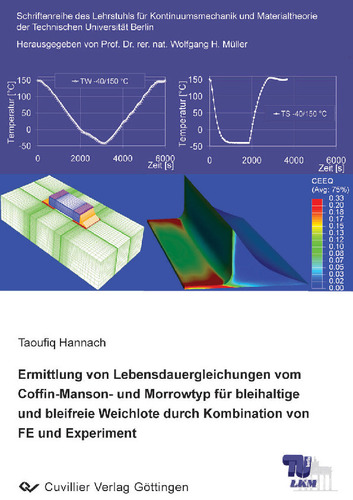
If experimentally determined lifetimes are plotted against the associated creep energy densities or creep strains occurring in the solder per thermal cycle, reliability parameters can be derived for the solder under investigation. On this basis, mathematical lifetime laws can be established. With the aid of these laws, lifetime predictions are possible without having to carry out additional experiments. The determination of the cyclically occurring creep energy densities must be carried out on the basis of FE simulations. The determination of creep strains and creep energy densities is possible with the aid of FE simulations.
Within the framework of the present work, reliability parameters are determined on the basis of FE simulations and experimentally determined lifetimes. These lifetimes were determined within the framework of two large research projects, the projects LIVE and W5.
All investigations in the present work relate to solder joints of ceramic capacitors and resistors. The long-term objective is to demonstrate the validity of the determined lifetime relationships for arbitrary solder geometries, so that these could be regarded as material parameters.
| ISBN-13 (Printausgabe) | 3869552832 |
| ISBN-13 (Hard Copy) | 9783869552835 |
| ISBN-13 (eBook) | 9783736932838 |
| Final Book Format | A5 |
| Language | German |
| Page Number | 258 |
| Edition | 1 Aufl. |
| Book Series | Schriftenreihe des Lehrstuhls für Kontinuumsmechanik und Materialtheorie der Technischen Universität Berlin |
| Volume | 3 |
| Publication Place | Göttingen |
| Place of Dissertation | TU Berlin |
| Publication Date | 2010-03-25 |
| General Categorization | Dissertation |
| Departments |
Mechanical and process engineering
|


