
Cuvillier Verlag GmbH



| Departments | |
|---|---|
| Book Series (99) |
1417
|
| Nachhaltigkeit |
3
|
| Gesundheitswesen |
3
|
| Humanities |
2417
|
| Medienwissenschaften | 17 |
| Theology | 57 |
| Philosophy | 103 |
| Law | 431 |
| Economics | 867 |
| Social sciences | 423 |
| Sports science | 48 |
| Psychology | 233 |
| Educational science | 190 |
| History | 194 |
| Art | 111 |
| Cultural studies | 168 |
| Literary studies | 119 |
| Linguistics | 91 |
| Natural Sciences |
5433
|
| Engineering |
1823
|
| Common |
97
|
|
Leitlinien Unfallchirurgie
5. Auflage bestellen |
|
Advanced Search
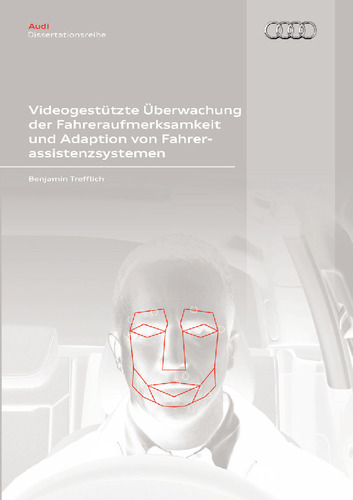
Videogestützte Überwachung der Fahreraufmerksamkeit und Adaption von Fahrerassistenzsystemen (Volume 26) (English shop)
Benjamin Trefflich (Author)Preview
Table of Contents, Datei (62 KB)
Extract, Datei (89 KB)
This work provides an overview of the systems and methods that allow conclusions to be drawn about the driver’s current state of attention. The focus is on monocular camera-based driver monitoring systems. Various approaches are discussed that make it possible to determine the driver’s visual focus of attention on the basis of such a system, and the particular importance of head orientation and gaze direction in this context is highlighted.
In a first step, an evaluation methodology is developed that makes it possible to assess camera-based driver monitoring systems in typical driving situations with regard to the measurement accuracy of head orientation and the coverage range achieved. The functional capability of this methodology is demonstrated in a first series of experiments.
Further series of experiments determine to what extent gaze direction and head orientation correlate with one another in typical driving situations and to what extent statements about driver attention can be made on the basis of head orientation alone. From this, various approaches of the author’s own on how head orientation can be interpreted with regard to driver attention are derived, implemented and assessed.
Building on these approaches to head-orientation-based determination of driver attention, the warning strategies of two advanced driver assistance systems (ADAS) with machine perception – originally only of the vehicle environment – are adapted prototypically to the driver’s attention. The ADAS modified for this purpose by way of example are, on the one hand, a lane departure warning system (LDW) and, on the other hand, an adaptive cruise control system (ACC). The aim of these adaptations is, on the one hand, to give the driver more reaction time in a hazardous situation in the event of inattention. On the other hand, the acceptance of the ADAS is to be increased by issuing its warnings only in critical situations, related to the driver’s state of attention (relevance aspect). Finally, the prototypical system designs of both ADAS are evaluated in test-subject studies, and the resulting findings are presented and discussed.
| ISBN-13 (Printausgabe) | 3869552492 |
| ISBN-13 (Hard Copy) | 9783869552491 |
| ISBN-13 (eBook) | 9783736932494 |
| Language | German |
| Page Number | 165 |
| Edition | 1 Aufl. |
| Book Series | Audi Dissertationsreihe |
| Volume | 26 |
| Publication Place | Göttingen |
| Place of Dissertation | Technische Universität Ilmenau |
| Publication Date | 2010-03-11 |
| General Categorization | Dissertation |
| Departments |
Psychology
Informatics Mechanical and process engineering |


