
Cuvillier Verlag GmbH



| Departments | |
|---|---|
| Book Series (99) |
1415
|
| Nachhaltigkeit |
3
|
| Gesundheitswesen |
3
|
| Humanities |
2413
|
| Natural Sciences |
5430
|
| Mathematics | 230 |
| Informatics | 320 |
| Physics | 982 |
| Chemistry | 1371 |
| Geosciences | 131 |
| Human medicine | 246 |
| Stomatology | 10 |
| Veterinary medicine | 112 |
| Pharmacy | 147 |
| Biology | 837 |
| Biochemistry, molecular biology, gene technology | 121 |
| Biophysics | 25 |
| Domestic and nutritional science | 45 |
| Agricultural science | 1006 |
| Forest science | 201 |
| Horticultural science | 20 |
| Environmental research, ecology and landscape conservation | 149 |
| Engineering |
1822
|
| Common |
97
|
|
Leitlinien Unfallchirurgie
5. Auflage bestellen |
|
Advanced Search
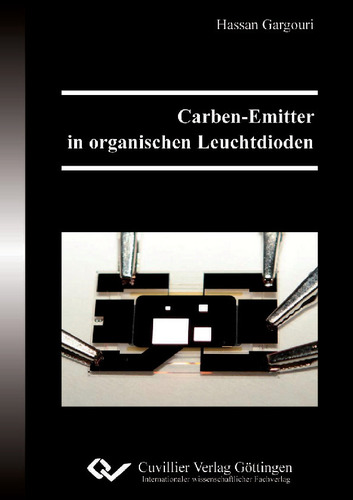
Carben-Emitter in organischen Leuchtdioden (English shop)
Hassan Gargouri (Author)Preview
Table of Contents, Datei (110 KB)
Extract, Datei (410 KB)
Organic light emitting diodes (OLEDs) have been the subject of intensive scientific research in recent years. The great interest in these innovative light sources, including in industry, is based on their simple and low-cost fabrication, their self-emissive capability and in particular their low energy consumption. Furthermore, the small thickness of the functional organic layers and their mechanical flexibility enable the fabrication of transparent and flexible OLEDs.
Thanks to the vast number of possible compounds, there are no limits to the synthesis of new organic materials. New substances with differing properties are thus synthesised every day. This work focuses on the development and investigation of new iridium carbene complexes with regard to their application in efficient and long-lived organic light emitting diodes. By targeted modification of the structure, triplet emitters with different emission colours covering the entire colour space can be prepared from this class of materials. Emitter dyes of this kind were prepared and provided by BASF SE.
In the first part of this work, an orange-red carbene complex was investigated. To optimise the efficiency of this dye, different matrices and transport materials as well as various device architectures were tested. By employing the dual emitting layer system, the optical and electrical properties of the OLEDs could be improved. Owing to the improved charge carrier balance achieved in this way, an increase in device lifetime by a factor of 15 at an initial luminance of 800 cd/cm² could be attained.
Carbene complexes emitting in the blue spectral range place additional demands on the choice of materials and on the layer sequence, owing to the high photon energy and the energetically high position of the triplet states. For this purpose, materials meeting these requirements were developed by the industrial partner and by the Institut für Makromolekulare Chemie of the University of Bayreuth. Within the framework of this work, these materials were investigated with respect to their stability in the OLED stack, on the basis of which a selection of the potential substances can be made.
In the second part, two-colour white and three-colour white OLEDs based on the carbene dyes were optimised. Various device architectures were investigated. The best CIE coordinates (Commission Internationale d’Eclairage, CIE) achieved with the two-colour white structure, CIE-x = 0.27 and CIE-y = 0.29, were close to the white region. To the observer, the emitted light was perceived as cool white. The lifetime of this structure was 40 hours at an initial luminance of 1000 cd/m². In order to hit the optimal white point (CIE-x = 0.33 and CIE-y = 0.33), the commercially available green-yellow dye Ir(ppy)3 was incorporated into the optimised two-colour white structure. The CIE coordinates achieved were CIE-x = 0.30 and CIE-y = 0.33. In addition to the relatively long lifetime of 90 and 800 hours at an initial luminance of 1000 cd/m² and 300 cd/m² respectively, the optimised three-colour white structure showed no change in the emission spectrum at different operating luminances and during degradation.
| ISBN-13 (Printausgabe) | 386955262X |
| ISBN-13 (Hard Copy) | 9783869552620 |
| ISBN-13 (eBook) | 9783736932623 |
| Language | German |
| Page Number | 164 |
| Edition | 1 Aufl. |
| Volume | 0 |
| Publication Place | Göttingen |
| Place of Dissertation | Universität Braunschweig |
| Publication Date | 2010-02-15 |
| General Categorization | Dissertation |
| Departments |
Chemistry
Electrical engineering |


