
Cuvillier Verlag GmbH



| Departments | |
|---|---|
| Book Series (99) |
1415
|
| Nachhaltigkeit |
3
|
| Gesundheitswesen |
3
|
| Humanities |
2411
|
| Natural Sciences |
5429
|
| Mathematics | 230 |
| Informatics | 320 |
| Physics | 982 |
| Chemistry | 1371 |
| Geosciences | 131 |
| Human medicine | 246 |
| Stomatology | 10 |
| Veterinary medicine | 112 |
| Pharmacy | 147 |
| Biology | 837 |
| Biochemistry, molecular biology, gene technology | 121 |
| Biophysics | 25 |
| Domestic and nutritional science | 45 |
| Agricultural science | 1005 |
| Forest science | 201 |
| Horticultural science | 20 |
| Environmental research, ecology and landscape conservation | 148 |
| Engineering |
1821
|
| Common |
97
|
|
Leitlinien Unfallchirurgie
5. Auflage bestellen |
|
Advanced Search
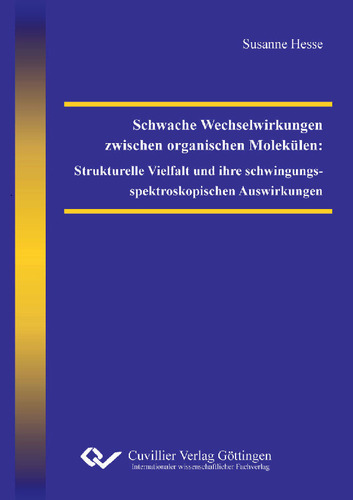
Schwache Wechselwirkungen zwischen organischen Molekülen: Strukturelle Vielfalt und ihre schwingungsspektroskopischen Auswirkungen (English shop)
Susanne Hesse (Author)Preview
Table of Contents, Datei (54 KB)
Extract, Datei (260 KB)
Intermolecular interactions, and hydrogen bonds in particular, have long been the subject of a wide variety of investigations. In most cases, contacts between N-H and O-H bonds on the one hand and lone pairs on N and O atoms on the other are considered. Interactions of this kind form the basic framework of proteins and DNA. Apart from these typical forms of intermolecular interaction, however, there also exist more weakly pronounced variants which contribute to the formation of aggregates either on their own or as an additional, structure-determining factor. Here, atypical forms of the hydrogen bond should be mentioned first. A well-known example is the CH group, whose significance as a hydrogen bond donor was long doubted but is now established. In addition, ?-systems are available as hydrogen bond acceptors. Beyond the topic of hydrogen bonds as well, there are attractive interactions that can lead to the formation of aggregates. They are due to electrostatic and inductive interactions as well as dispersion interactions. A good example of electrostatics is CO2, whose self-aggregates have already been investigated in detail and which, in combination with methyl acetate, is also treated in this work. Induction and dispersion are especially important when one or both binding partners exhibit no pronounced charge separation. In the framework of this thesis, such weak interactions between molecules were investigated by means of jet FTIR spectroscopy and comparison with quantum chemical calculations. The cooling in the supersonic jet ensures that aggregates that are often not stable at room temperature become spectroscopically detectable. Since cluster formation generally leads to visible changes in the vibrational spectrum, a separation of the aggregates from the monomers is possible. The systems treated in this work can be divided into structures with CH functions (halogenated hydrocarbons), NH functions (above all pyrrolidine and pyrrole derivatives) and carbonyl groups (lactones, esters, hydroxy esters). Each of these groups offers a wealth of examples for the formation of molecular aggregates involving weak interactions, which could be detected with the aid of vibrational spectroscopy in the supersonic jet.
| ISBN-13 (Printausgabe) | 3869552468 |
| ISBN-13 (Hard Copy) | 9783869552460 |
| ISBN-13 (eBook) | 9783736932463 |
| Language | German |
| Page Number | 304 |
| Edition | 1 Aufl. |
| Volume | 0 |
| Publication Place | Göttingen |
| Place of Dissertation | Universität Göttingen |
| Publication Date | 2010-02-10 |
| General Categorization | Dissertation |
| Departments |
Chemistry
|


