
Cuvillier Verlag GmbH



| Departments | |
|---|---|
| Book Series (99) |
1415
|
| Nachhaltigkeit |
3
|
| Gesundheitswesen |
3
|
| Humanities |
2411
|
| Natural Sciences |
5429
|
| Mathematics | 230 |
| Informatics | 320 |
| Physics | 982 |
| Chemistry | 1371 |
| Geosciences | 131 |
| Human medicine | 246 |
| Stomatology | 10 |
| Veterinary medicine | 112 |
| Pharmacy | 147 |
| Biology | 837 |
| Biochemistry, molecular biology, gene technology | 121 |
| Biophysics | 25 |
| Domestic and nutritional science | 45 |
| Agricultural science | 1005 |
| Forest science | 201 |
| Horticultural science | 20 |
| Environmental research, ecology and landscape conservation | 148 |
| Engineering |
1821
|
| Common |
97
|
|
Leitlinien Unfallchirurgie
5. Auflage bestellen |
|
Advanced Search
Die Linalool-Dehydratase-Isomerase aus dem nitratreduzierenden Betaproteobakterium Castellaniella defragrans 65Phen (English shop)
Danny Brodkorb (Author)Preview
Table of Contents, Datei (58 KB)
Extract, Datei (63 KB)
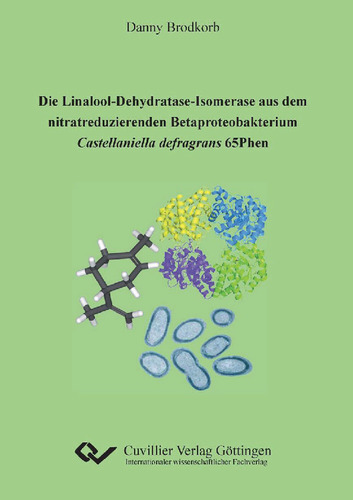
Monoterpenes have long been used in folk medicine. Cough drops, for example, often contain menthol or eucalyptol. The healing effect of these monoterpenoids, often in mixtures with other monoterpenes (essential oils), is attributed to the antibiotic properties of these natural compounds. Plants synthesise monoterpenes in large quantities: as a feeding deterrent, as a signalling substance between plants and as protection against evaporation. 127 million tons alone are released into the atmosphere each year. To date, little is known about the metabolism of monoterpenes in soil: monoterpenes in needle litter, for instance, contribute to the rapid spread of forest fires (more than one litre of monoterpenes per square metre is present there). For some years now, the degradation of monoterpenes by anaerobic, nitrate-respiring bacteria and methanogenic enrichment cultures has been under investigation. One of the denitrifying bacteria is Castellaniella (ex Alcaligenes) defragrans 65Phen. This organism mineralises monoterpenes in the absence of molecular oxygen. Under nitrate-reducing conditions, these hydrocarbons are completely oxidised to carbon dioxide. In this work, the enzyme activities of geraniol isomerase and linalool dehydratase were purified and enzymatically characterised. In a five-step purification protocol, the linalool dehydratase was purified to homogeneity. The protein also catalysed the isomerisation of geraniol to linalool. The thermodynamically unfavoured reverse reactions from myrcene to linalool and from linalool to geraniol were also measurable. The name linalool dehydratase-isomerase is therefore proposed for the new enzyme. It has a native molecular weight of 160 kDa and is a tetramer of a 40 kDa protein. Chiral gas chromatography analyses demonstrated the enantioselective isomerisation of geraniol via (S)-(+)-linalool to myrcene, with an enantiomeric excess of ≥99%. Thauera linaloolentis 47Lol showed a geraniol isomerase activity to (R,S)-linalool, Thauera terpenica 58Eu a geraniol dehydratase activity to myrcene. The gene of the linalool dehydratase-isomerase was identified by means of N-terminal protein sequencing in an existing fosmid sequence of C. defragrans. The gene sequence encodes a preprotein of 397 amino acids including an N-terminal signal peptide for a Sec-dependent translocation into the periplasm. The linalool dehydratase-isomerase is the first protein of a new protein family.
| ISBN-13 (Printausgabe) | 3869552131 |
| ISBN-13 (Hard Copy) | 9783869552132 |
| ISBN-13 (eBook) | 9783736932135 |
| Language | German |
| Page Number | 116 |
| Edition | 1 Aufl. |
| Volume | 0 |
| Publication Place | Göttingen |
| Place of Dissertation | Universität Bremen |
| Publication Date | 2010-01-04 |
| General Categorization | Dissertation |
| Departments |
Chemistry
Biology Agricultural science |


