
Cuvillier Verlag GmbH



| Departments | |
|---|---|
| Book Series (99) |
1415
|
| Nachhaltigkeit |
3
|
| Gesundheitswesen |
3
|
| Humanities |
2411
|
| Natural Sciences |
5430
|
| Engineering |
1821
|
| Engineering | 292 |
| Mechanical and process engineering | 872 |
| Electrical engineering | 700 |
| Mining and metallurgy | 30 |
| Architecture and civil engineering | 76 |
| Common |
97
|
|
Leitlinien Unfallchirurgie
5. Auflage bestellen |
|
Advanced Search
Qualifizierung von Rußpartikeln durch Kombinationen von elektrostatischen Feldeinflüssen (Volume 80) (English shop)
Gerald Hauser (Author)Preview
Extract, PDF (130 KB)
Table of Contents, PDF (260 KB)
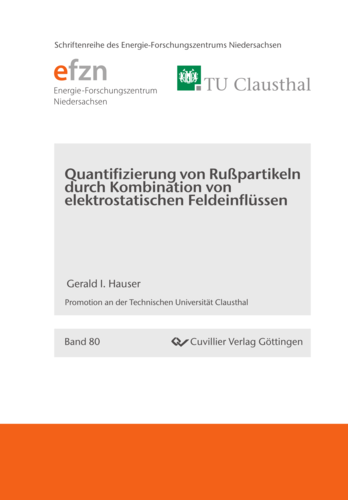
This doctoral thesis sets out the theoretical foundations for an electrostatically operating sensor for electrically conductive, airborne particles and verifies them experimentally using the example of soot particles. The operating principle of the sensor is represented in a mathematical model.
The forces acting on the particles in order to induce a directed motion are defined and calculated. The charge separation induced within the particles by the electric field, which produces a resulting force in the direction of the increasing field, is not essential for particle motion. The most essential property for the propulsion of a particle is its intrinsic charge, which, in interaction with the external electric field, provides the strongest force.
Furthermore, it is shown that the number of particles deposited on the measuring electrode is independent of the flow velocity of the carrier gas.
The particles deposited on the measuring electrode agglomerate into dendrites, at whose tips electric charges concentrate. When the dendrites break off, their charge is transported away from the measuring electrode. The current generated by this charge transport, on the order of picoamperes, is proportional to the soot concentration.
It is determined by calculation that the soot charge measurement method operates independently of particle size in the range from 40 nm to approx. 400 nm.
A particle sensor was fabricated, measured and calculated.
The theoretical findings regarding the independence of the measurement signal from the gas velocity and its quadratic dependence on the electric field strength between the electrodes of the sensor can be confirmed experimentally.
| ISBN-13 (Hard Copy) | 9783736979314 |
| ISBN-13 (eBook) | 9783736969315 |
| Final Book Format | A5 |
| Language | German |
| Page Number | 174 |
| Lamination of Cover | matt |
| Edition | 1 |
| Book Series | Schriftenreihe des Energie-Forschungszentrums Niedersachsen (EFZN) |
| Volume | 80 |
| Publication Place | Göttingen |
| Place of Dissertation | Clausthal |
| Publication Date | 2024-01-31 |
| General Categorization | Dissertation |
| Departments |
Energy engineering
|
| Keywords | Soot particles, electrical engineering, energy technology, field influences, physics, qualification, particles, mathematics, sensor, measuring electrodes, soot loading, particles, particle sensor, field strength, electricity, Carbon black articles, electrical engineering, energy technology, field influences, Soot load |


