
Cuvillier Verlag GmbH



| Departments | |
|---|---|
| Book Series (99) |
1415
|
| Nachhaltigkeit |
3
|
| Gesundheitswesen |
3
|
| Humanities |
2411
|
| Medienwissenschaften | 17 |
| Theology | 57 |
| Philosophy | 103 |
| Law | 430 |
| Economics | 863 |
| Social sciences | 423 |
| Sports science | 48 |
| Psychology | 233 |
| Educational science | 190 |
| History | 194 |
| Art | 111 |
| Cultural studies | 167 |
| Literary studies | 118 |
| Linguistics | 91 |
| Natural Sciences |
5429
|
| Engineering |
1821
|
| Common |
97
|
|
Leitlinien Unfallchirurgie
5. Auflage bestellen |
|
Advanced Search
Die Vögel im Naturkunde-Museum Bamberg (English shop)
Eine Dokumentation (Textteil)
Gertrud Döllner (Author)Preview
Extract, PDF (270 KB)
Table of Contents, PDF (110 KB)
The Naturkunde-Museum Bamberg – the oldest museum in our city – owes its origins to Prince-Bishop Franz Ludwig von Erthal (reigned 1779-1795), who in 1791 had designated it as a teaching institution for the University of Bamberg. Following an extensive remodelling of the north wing of the former Jesuit College, the future collection was to be housed there. The Prince-Bishop did not live to see the completion and furnishing of the rooms, and the Napoleonic Wars delayed the project for several further years.
Only when, in the course of secularisation, the former conventual Joseph Dionys Linder (1762-1838) took over the direction of what was now the “Electoral Cabinet of Natural History” (from 1806 the “Royal Cabinet of Natural History”) on 30 August 1803 was it able to develop into the internationally renowned museum it became.
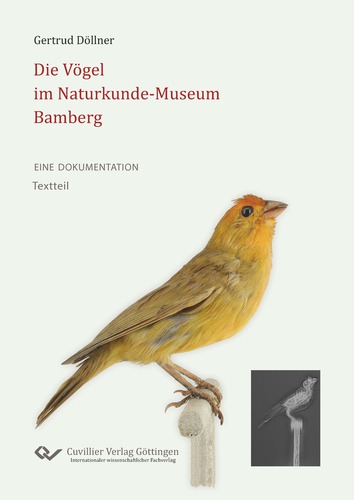
Linder as “Cabinet Director” was a stroke of good fortune for the young museum, for he had already looked after the cabinet of natural history at Banz Monastery and, when the monastery was dissolved, had been able to rescue almost all of its natural history specimens – among them more than 250 bird exhibits – by transferring them to the Bamberg cabinet. The Saffron Finch Sicalis flaveola (Linnaeus, 1766) from South America can still be documented today.
Linder was animated by such zeal for his cabinet that he used both his pension as a former conventual and his salary as curator almost exclusively for the acquisition of natural history specimens and for the furnishing of the cabinet.
Dr Andreas Haupt, Linder’s successor in office, also enriched the collection with important natural history specimens after several rooms had been added to what had originally been the only room, today known as the Bird Hall.
Dr Haupt maintained an extensive correspondence with almost all the natural scientists of note in the 19th century.
But even in Linder’s day, distinguished figures visited the Royal Cabinet of Natural History in Bamberg, such as Lorenz Oken, Hermann Fürst Pückler (von) Muskau, Johann Baptist (von) Spix, and also H.R.H. Crown Prince Ludwig, who in 1811 had a golden eagle sent to the cabinet of natural history.
Of the many birds that found their way into the Naturkunde-Museum over a period of more than 200 years, only 1,630 specimens remain; nevertheless, Bamberg possesses a taxonomically and historically important bird collection. After all, the display cases contain birds that are today regarded globally as rare or extinct, birds of which only a few exist in museum collections, birds from significant collectors and possibly also paratypes from the Brazilian expedition (1817-1820) of Johann Baptist (von) Spix.
| ISBN-13 (Hard Copy) | 9783736979352 |
| ISBN-13 (eBook) | 9783736969353 |
| Final Book Format | A4 |
| Language | German |
| Page Number | 184 |
| Lamination of Cover | glossy |
| Edition | 1. |
| Publication Place | Göttingen |
| Publication Date | 2024-02-08 |
| General Categorization | Non-Fiction |
| Departments |
History
Natural Sciences |
| Keywords | Royal Natural History Cabinet Bamberg, Natural History Museum Bamberg, Dionys Linder, Banz Abbey, Deed of foundation, Dr Andreas Haupt, Johann Natterer, Ornithologist, Toucan (Selenidera culik), Johann Friedrich Sturm, Ramphastidae, Carl Michahelles, Vögel, Birds, Vogelsaal, Room of Birds, Dokumentation, Documentation, Safran-Gilbammer (Sicalis flaveola), Saffron finch, Schuhschnabel (Balaeniceps), Shoebill, Wandertaube (Ectopistes migratorius), Passenger pigeon, Zahntaube (Didunculus strigrostris), Toothed pigeon, Kasuar (casuarius), Cassowary, Afrikanischer Strauß (Struthio camelus), Ostrich Bird, Dr Johann Lucas Schönlein, Johann Baptist von Spix, Godeffroy trading house, Hamburg, Dr Eduard Graeffe, Amalie Dietrich, Otto Finsch, Andrew Garrett, Johann Stanislaus Kubary, Johann Friedrich Leu, Wilhelm Schmidt, Josef Erhard, Royal Natural History Cabinet Stuttgart, Ferdinand von Kraus, Dr Carl Theodor Ernst von Siebold, Museum Naturalis Leiden, Dr Hermann Schlegel, Dr Matthäus Kirchner, Emil Weiske, Ignaz Kress, Andreas Johannes Jäckel, Steinadler (Aquila chrysaetos), Golden eagle |


